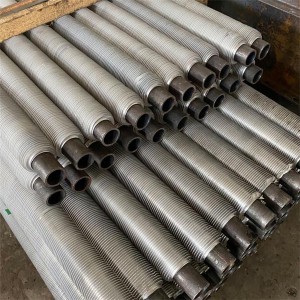
Spiral Finned Vacuum Heat Pipes for Efficient Heat Recovery and Industrial Heat Exchangers

Introduction
Vacuum heat pipes and gravity heat pipes are widely used for transferring heat efficiently between different temperature zones without requiring a mechanical circulation pump.
For industrial heat recovery systems, however, the heat pipe itself is only part of the solution. The external heat transfer surface also plays an important role, especially when heat is transferred between the heat pipe and air or another gas.
Our spiral finned vacuum heat pipes and gravity heat pipes combine a sealed heat pipe with a spiral fin welded onto the outer surface of the pipe. The fin increases the external heat transfer area, while the internal working fluid transfers heat through evaporation and condensation.
This configuration has been successfully supplied for projects in Egypt, Tanzania, and Kenya. Several customers have continued to reorder these heat pipes over the following years, providing practical feedback on their long-term use in industrial heat recovery applications.
What Is a Spiral Finned Vacuum Heat Pipe?
A spiral finned vacuum heat pipe is a sealed heat transfer tube with a vacuum environment inside and a spiral fin structure welded onto its external surface.
The basic structure normally consists of:
- A metal heat pipe shell
- Internal working fluid
- Sealed vacuum space
- Evaporation section
- Condensation section
- Spiral fins welded onto the external tube surface
The internal working fluid is selected according to the required operating temperature range.
Under suitable operating conditions, the working fluid absorbs heat in the evaporation section and changes from liquid to vapor. The vapor then moves toward the cooler condensation section, where it releases latent heat and condenses back into liquid.
The condensed liquid returns to the evaporation section, allowing the heat transfer cycle to continue.
Unlike conventional heat exchangers that rely primarily on sensible heat transfer through a circulating fluid, a heat pipe uses the phase-change process of the internal working fluid to transport thermal energy.
How Does a Gravity Heat Pipe Work?
A gravity heat pipe works according to the same basic evaporation-condensation principle, but the return of the condensed liquid depends mainly on gravity.
The operating process can be simplified into four steps:
1. Heat Absorption
The lower or heating section of the heat pipe is exposed to a hot gas, exhaust stream, process air, or another heat source.
The working fluid inside the sealed pipe absorbs heat.
2. Evaporation
When the working fluid reaches its evaporation temperature, it changes from liquid into vapor.
Because the system operates under vacuum, the boiling temperature of the working fluid can be significantly lower than its normal atmospheric boiling point.
3. Vapor Condensation
The vapor travels toward the cooler section of the heat pipe.
When it contacts the cooler internal wall, it releases its latent heat and condenses back into liquid.
4. Gravity Return
In a gravity heat pipe, the condensed liquid flows back toward the hot section under gravity.
The cycle then repeats continuously.
This process does not require a conventional mechanical pump to circulate the working fluid.
Why Add Spiral Fins to a Heat Pipe?
A bare heat pipe can transfer heat effectively internally, but the external surface area available for air-side heat transfer is limited.
This becomes particularly important in applications involving:
- Hot air
- Exhaust gas
- Flue gas
- Combustion gases
- Process air
- Drying air
- Ventilation air
Gas has a relatively low heat transfer coefficient compared with many liquids. Therefore, increasing the external heat transfer area can significantly improve the overall heat exchanger performance.
This is where the spiral welded fin becomes important.
The spiral fin creates a much larger external heat transfer surface around the heat pipe, allowing more heat to be exchanged with the surrounding air or gas within a relatively compact heat exchanger.
Therefore, the system combines two different heat transfer advantages:
Internal phase-change heat transfer + enlarged external finned surface
This is one of the main reasons spiral finned heat pipes are attractive for air-side heat recovery systems.
Spiral Welded Fin Structure
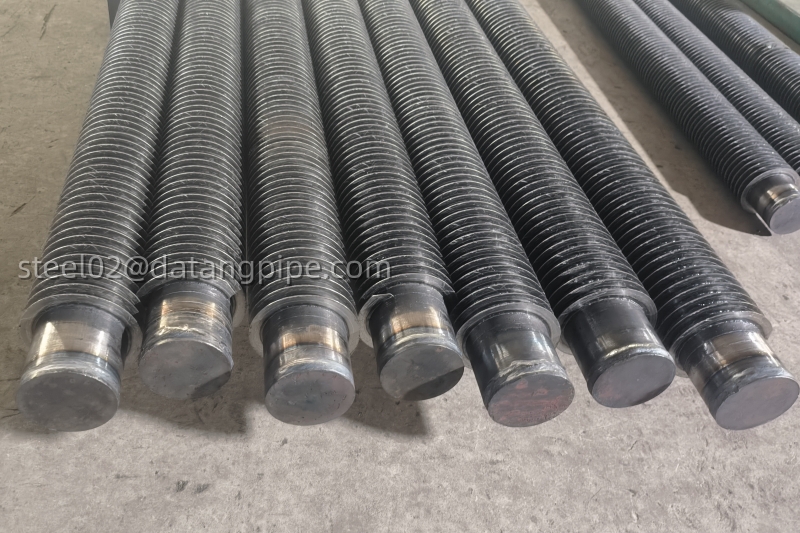
The fin is continuously formed into a spiral around the external surface of the heat pipe and welded to the tube.
Compared with a bare tube, the spiral fin provides substantially more surface area within the same installation envelope.
The actual fin geometry can be designed according to the customer’s heat exchanger requirements, including factors such as:
- Tube outside diameter
- Fin height
- Fin thickness
- Fin pitch
- Fin material
- Tube material
- Required heat transfer capacity
- Gas-side pressure drop
- Operating temperature
- Corrosion conditions
The fin and tube materials can also be selected according to the operating environment.
For example, carbon steel, stainless steel, aluminum and other materials may be considered depending on the application and temperature conditions.
Important: The final tube, fin material and working fluid should always be selected based on the actual operating conditions rather than by using one standard configuration for every project.
Vacuum Heat Pipe vs. Conventional Heat Exchanger Tube
One important difference between a heat pipe and a conventional heat exchanger tube is the way heat is transported.
In a conventional heat exchanger, a fluid generally needs to circulate through the tube or across the heat transfer surface.
A heat pipe, by contrast, contains a sealed working fluid. Heat is transported through repeated evaporation and condensation inside the tube.
This can provide several engineering advantages:
| Feature | Vacuum / Gravity Heat Pipe | Conventional Heat Exchanger Tube |
|---|---|---|
| Internal heat transfer mechanism | Evaporation and condensation | Sensible heat transfer |
| Working fluid circulation | Passive | Usually requires fluid circulation |
| Mechanical pump inside heat pipe system | Not required for the heat pipe cycle | Often required depending on system |
| External finning | Can be added | Common |
| Modular heat exchanger design | Excellent | Excellent |
| Air-side applications | Highly suitable | Suitable |
| Heat recovery applications | Highly suitable | Widely used |
The actual performance advantage depends on the heat source, temperature difference, gas flow rate, heat pipe design and complete heat exchanger configuration.
Main Applications of Spiral Finned Heat Pipes
Spiral finned vacuum and gravity heat pipes can be integrated into different types of heat recovery equipment.
1. Industrial Waste Heat Recovery
Industrial processes often discharge hot exhaust gases that still contain significant amounts of recoverable thermal energy.
Instead of releasing all of this heat directly to the atmosphere, a heat pipe heat exchanger can transfer part of the thermal energy to incoming air or another useful air stream.
Potential applications include:
- Industrial furnaces
- Boilers
- Drying systems
- Kilns
- Heating systems
- Process exhaust systems
- Manufacturing plants
The recovered heat can then be used to preheat combustion air, process air or drying air.
2. Air-to-Air Heat Recovery
Heat pipes are particularly interesting for air-to-air heat recovery because the hot and cold air streams can be separated.
A typical arrangement uses one side of the heat exchanger as the hot-air section and the other side as the cold-air section.
Heat absorbed from the hot air causes the working fluid to evaporate.
The vapor transfers to the colder section and condenses, releasing heat to the incoming cold air.
This allows heat to move from one air stream to another without directly mixing the two streams.
3. Industrial Drying Systems
Drying processes often require a continuous supply of heated air.
At the same time, the exhaust air leaving the dryer may still contain considerable thermal energy.
A spiral finned heat pipe heat exchanger can recover part of this energy and transfer it to fresh incoming air.
This can help reduce the amount of external heating energy required by the drying system.
Possible applications include:
- Wood drying
- Agricultural product drying
- Food processing
- Industrial material drying
- Textile drying
- Biomass drying
4. Boiler and Furnace Heat Recovery
Boilers and industrial furnaces produce high-temperature exhaust gases.
A heat pipe heat recovery system can be installed downstream of the hot gas source to recover thermal energy.
The recovered heat can potentially be used for:
- Combustion air preheating
- Fresh air preheating
- Process air heating
- Drying air heating
- Space or equipment heating
The appropriate heat pipe working fluid and material must be selected according to the exhaust temperature and chemical environment.
5. Waste Heat Recovery in Cement and Process Industries
Large industrial processes such as cement production generate substantial quantities of hot gases.
Where gas temperature and operating conditions are appropriate, heat pipe heat exchangers can be considered for recovering otherwise wasted thermal energy.
The modular nature of heat pipes also allows multiple individual tubes to be assembled into a larger heat exchanger bank.
Why Customers Choose Spiral Finned Heat Pipes
From an engineering perspective, several characteristics make this type of heat pipe attractive.
Passive Heat Transfer
The heat transfer cycle inside the sealed heat pipe can operate without a mechanical circulation pump for the working fluid.
Large External Heat Transfer Area
The spiral fin substantially increases the external heat transfer area compared with a bare tube.
Compact Heat Exchanger Design
The increased surface area can help achieve the required heat transfer capacity within a relatively compact heat exchanger arrangement.
Separation of Hot and Cold Air
In air-to-air heat recovery systems, the two air streams can remain physically separated.
Modular Construction
Individual heat pipes can be arranged into heat exchanger banks according to the required capacity and installation dimensions.
Long-Term Industrial Application
Properly designed and manufactured heat pipes are suitable for continuous industrial operation when the material, working fluid, sealing, welding and operating conditions are correctly matched.
Our Spiral Finned Heat Pipe Projects in Africa
Our spiral finned heat pipes have already been supplied for projects in Egypt, Tanzania and Kenya.
These projects are particularly valuable because they provide practical operating experience beyond laboratory testing.
Customers have reported positive performance during actual operation, and some customers have continued to purchase the same type of heat pipes from us repeatedly over several years.
The repeat orders are important because they indicate that the products have continued to meet the customers’ requirements after being put into real industrial service.
Rather than presenting the product only through theoretical performance data, these projects provide practical evidence of its use in different African industrial environments.
Project experience: Spiral finned vacuum/gravity heat pipes have been supplied to customers in Egypt, Tanzania and Kenya, with repeat orders received from customers after successful operation.
If you have actual project photos, I strongly recommend replacing generic images with your own finished tubes, production photos, installation photos and customer project photos. These will make the case-study section much more credible.
How We Design Heat Pipes for Different Applications
There is no single heat pipe specification suitable for every industrial application.
For a new project, we normally need to understand the actual operating conditions before determining the appropriate design.
Important parameters may include:
- Heat source temperature
- Heat source type
- Cold-side air temperature
- Required outlet temperature
- Gas flow rate
- Required heat transfer capacity
- Working pressure
- Operating orientation
- Heat exchanger dimensions
- Tube material
- Fin material
- Fin pitch
- Corrosive components in the gas
- Required service life
Based on these parameters, the heat pipe structure, working fluid, fin configuration and heat exchanger arrangement can be evaluated.
For gravity heat pipes in particular, installation orientation is important because the return of condensate relies on gravity.
Manufacturing of Spiral Finned Vacuum Heat Pipes
The manufacturing process is an important factor in the reliability of a sealed heat pipe.
A typical production process may include:
Tube preparation → Spiral fin forming → Fin-to-tube welding → Cleaning → Working fluid filling → Vacuum evacuation → Sealing → Inspection → Performance testing
The fin welding process needs to provide a reliable connection between the spiral fin and the tube because the external fin is responsible for transferring heat between the surrounding gas and the heat pipe wall.
The vacuum and sealing process is equally important.
The internal environment must be properly prepared and sealed so that the heat pipe can maintain its intended operating conditions during service.
Depending on the project requirements, inspection and testing can be arranged according to the customer’s technical specifications.
Spiral Finned Heat Pipe Manufacturer for Custom Heat Recovery Solutions
Our approach is not limited to supplying standard finned tubes.
For heat pipe applications, the tube itself is only one part of the complete thermal solution.
We can work with customers based on their actual operating conditions and help determine an appropriate configuration for the required application.
This may include evaluating:
- Heat pipe dimensions
- Tube and fin materials
- Spiral fin configuration
- Working fluid selection
- Operating temperature range
- Heat exchanger arrangement
- Heat recovery requirements
The final design should be based on the complete operating condition rather than simply selecting a heat pipe from a standard catalog.
FAQ About Spiral Finned Vacuum Heat Pipes
What is a vacuum heat pipe?
A vacuum heat pipe is a sealed heat transfer device containing a working fluid under controlled vacuum conditions. Heat is transferred through evaporation and condensation of the internal working fluid.
What is a gravity heat pipe?
A gravity heat pipe is a heat pipe in which condensed working fluid returns to the evaporation section primarily under the influence of gravity.
Why are fins welded onto the heat pipe?
The fins increase the external heat transfer area and improve heat exchange between the heat pipe surface and surrounding air or gas.
Where are spiral finned heat pipes used?
They can be used in industrial waste heat recovery, air-to-air heat recovery, drying systems, boiler exhaust heat recovery, furnace systems and other applications involving gas-side heat transfer.
Can the heat pipe be customized?
Yes. Heat pipe dimensions, tube and fin materials, fin geometry, working fluid and other parameters can be evaluated according to the actual operating conditions.
What information is needed for heat pipe selection?
Typical information includes heat source temperature, cold-side temperature, gas flow rate, required heat recovery capacity, installation orientation, gas composition and heat exchanger dimensions.
Conclusion
A spiral finned vacuum heat pipe combines phase-change heat transfer inside the sealed tube with an enlarged external heat transfer surface created by the spiral welded fin.
This combination makes it particularly suitable for air-side heat transfer and industrial waste heat recovery applications where efficient thermal transfer, compact equipment and passive operation are important.
Our spiral finned vacuum and gravity heat pipes have already been supplied for projects in Egypt, Tanzania and Kenya, with customers reporting positive operating results and continuing to place repeat orders over the years.
For a new heat recovery project, the most important step is not simply choosing a heat pipe type, but matching the tube structure, working fluid, fin configuration and heat exchanger design to the actual operating conditions.
If you can provide the basic temperature, airflow and heat recovery requirements of your project, we can evaluate a suitable heat pipe configuration for your application.