
G-Type Embedded vs. Spiral-Wound L, LL, and KL Knurled Finned Tubes: How to Choose the Right Heat Exchanger Solution


G-Type Embedded vs. Spiral-Wound L, LL, and KL Knurled Finned Tubes: How to Choose the Right Heat Exchanger Solution
Not sure which finned tube type suits your heat exchanger? Compare G-type embedded fin tube, L-type fin tube, LL-type fin tube, and KL knurled spiral-wound tubes. Learn their advantages, limitations, and ideal applications — with a practical selection guide.
Introduction
Finned tubes are the workhorses of air-cooled heat exchangers, waste heat recovery units, and industrial radiators. But choosing the wrong fin type can lead to poor heat transfer, frequent fouling, or premature failure — especially in harsh or high-temperature environments.
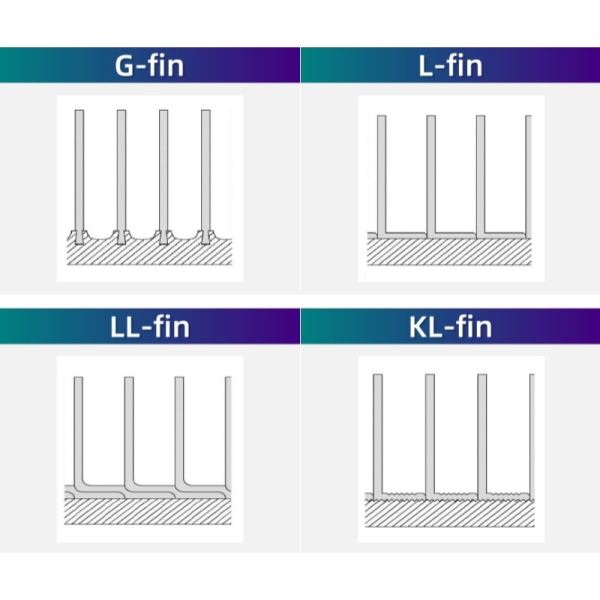
Four common designs dominate the market:
- G-type embedded finned tubes (grooved, embedded fins)
- Spiral-wound L-type (wrapped L-shaped foot)
- Spiral-wound LL-type (overlapped L-foot)
- KL knurled fin tube / knurled spiral-wound (cold-formed with knurling)
Each has unique mechanical and thermal characteristics. This guide explains their differences, advantages, and best-fit operating conditions — so you can make a confident, cost-effective decision.
Quick Comparison Table
| Feature | G-Type Embedded | L-Type (Spiral-Wound) | LL-Type (Overlapped L) | KL Knurled (Spiral) |
|---|---|---|---|---|
| Fin-to-tube bond | Mechanical (groove) | Wrapped, not bonded | Wrapped with overlap | Cold-welded via knurling |
| Max operating temp. | ~400°C (750°F) | ~150°C (300°F) | ~180°C (355°F) | ~260°C (500°F) |
| Corrosion protection | Good (tube covered) | Poor (tube exposed between fins) | Excellent (full tube coverage) | Moderate |
| Fin material | Aluminum, copper, steel | Mostly aluminum | Aluminum | Aluminum (most common) |
| Typical fin density | Medium–High (up to 10 FPI) | Low–Medium (4–8 FPI) | Medium (6–10 FPI) | Medium–High (8–12 FPI) |
| Mechanical strength | Very high | Low | Medium | High (cold-formed) |
| Cost | Medium–High | Low | Medium | Medium |
1. G-Type Embedded Finned Tubes
How It Works
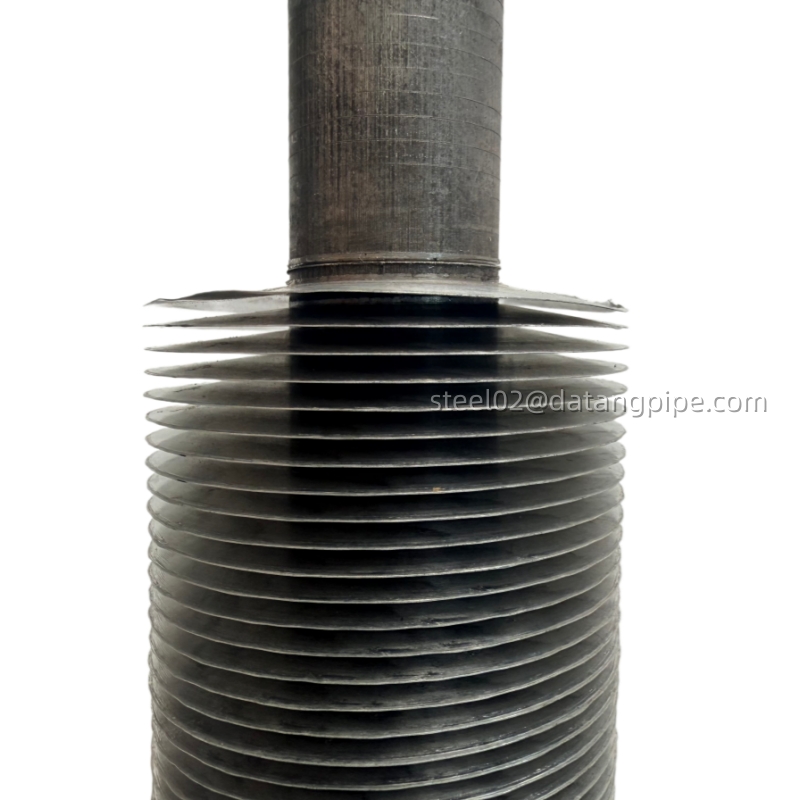
A groove is rolled or machined into the bare tube, then a metal strip (fin) is embedded under tension into the groove. The groove walls are then closed slightly to lock the fin firmly.
Key Advantages
- High temperature resistance – up to 400°C (750°F), suitable for superheaters or gas-to-air heat exchangers.
- Excellent mechanical strength – fins stay tight even under thermal cycling and vibration.
- Good heat transfer – direct metal-to-metal contact without air gaps.
- Compatible with steel fins – can use carbon or stainless steel fins for aggressive flue gases.
Limitations
- Higher manufacturing cost than L/LL types.
- Not suitable for very corrosive outdoor environments (tube surface partially exposed between grooves).
Best Applications
- Waste heat recovery boilers (high exhaust temperature)
- Air-cooled heat exchangers in refineries & petrochemical plants
- Gas turbine recuperators
- High-temperature industrial radiators (>200°C)
✅ Choose G-type when: operating temperature exceeds 180°C, or mechanical loads (vibration, frequent start/stop) are severe.
2. Spiral-Wound L-Type Finned Tubes
How It Works
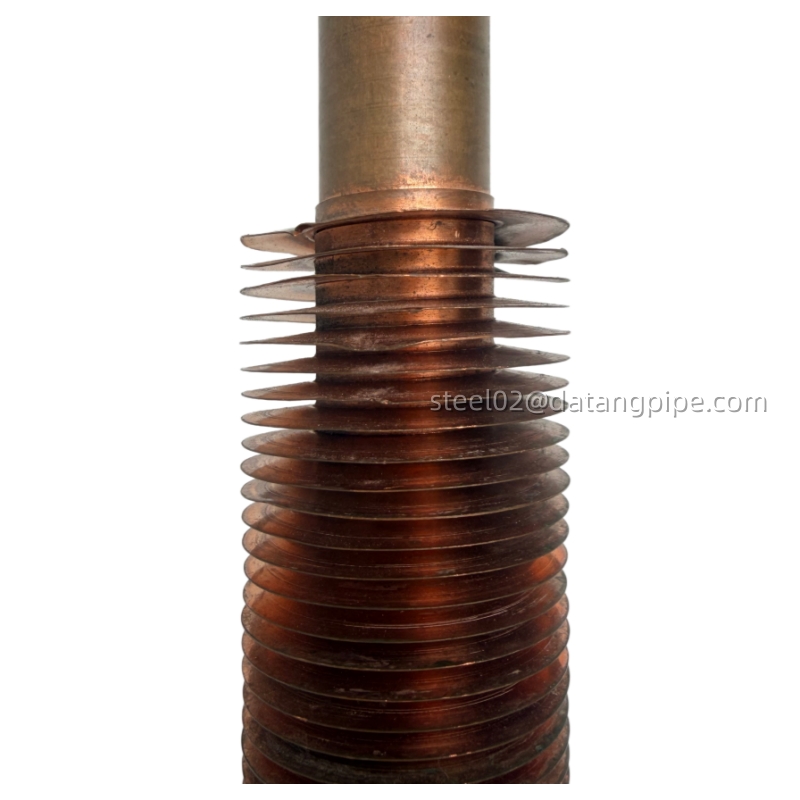
A flat aluminum strip is formed into an L-shaped cross-section, then wound helically around the tube. The “L foot” rests against the tube surface without bonding.
Key Advantages
- Lowest cost – simple winding process, no pre-grooving or special tools.
- Easy to repair – damaged sections can be unwound and replaced.
- Lightweight – ideal for low-load structures.
Limitations
- Low max temperature (~150°C / 300°F) – aluminum fins relax above this.
- Poor corrosion resistance – tube is exposed between fin turns, leading to localized pitting in salty or acidic environments.
- Low fin-to-tube contact – air gaps reduce thermal efficiency over time.
Best Applications
- HVAC air-cooled condensers (clean indoor or mild outdoor conditions)
- Engine cooling radiators (low-temperature water/glycol circuits)
- Low-cost industrial coolers where budget is the primary driver
⚠️ Avoid L-type when: temperature exceeds 150°C, or the unit is installed near coastlines or chemical plants.
3. Spiral-Wound LL-Type (Overlapped L-Foot)
How It Works
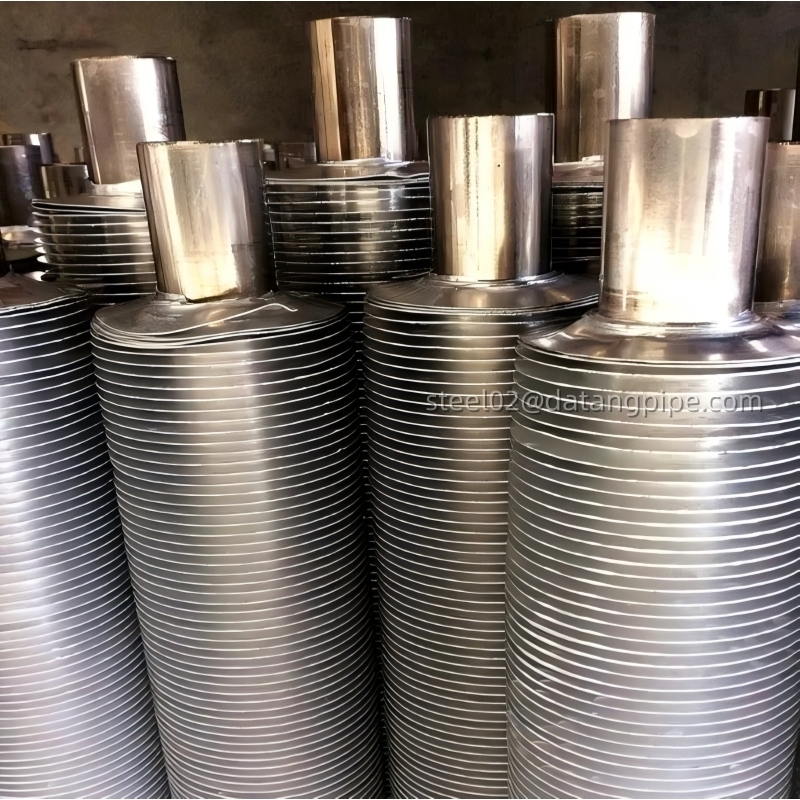
An enhanced L-fin where the vertical foot is wider, and each fin turn overlaps the previous foot — fully covering the tube surface. No bare metal remains exposed.
Key Advantages
- Superior corrosion protection – continuous aluminum layer over the entire tube.
- Better temperature limit than L-type (~180°C / 355°F).
- Moderate cost – only slightly more expensive than L-type.
- Improved fin rigidity – overlapping reduces vibration loosening.
Limitations
- Still limited to ~180°C (aluminum softening).
- Lower fin density than G-type or KL.
- Not recommended for heavy mechanical shock (e.g., tube cleaning with high-pressure water jets).
Best Applications
- Air coolers in marine environments (offshore platforms, ships)
- Chemical plant fin-fan coolers (corrosive atmospheres)
- Refrigeration condensers (ammonia or CO₂, moderate temp)
✅ Choose LL-type when: corrosion is a concern, but temperature is below 180°C and budget doesn’t allow G-type.
4. KL Knurled (Knurled Spiral-Wound) Finned Tubes
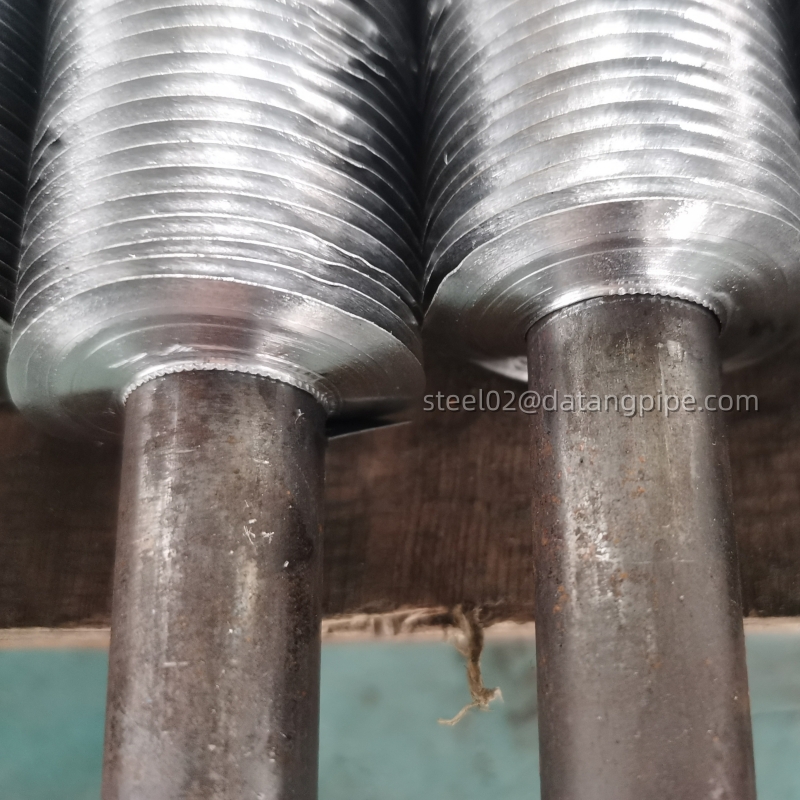
How It Works
A knurling tool creates a rough, ridged pattern on the tube surface. Then an aluminum fin strip is wound under high tension. The knurling “bites” into the fin foot, forming a cold-welded mechanical bond.
Key Advantages
- High heat transfer efficiency – excellent metal-to-metal contact without grooves or brazing.
- Good temperature resistance – up to 260°C (500°F) for aluminum fins.
- Strong bond – resists loosening from thermal cycling.
- Higher fin density possible (8–12 FPI) for compact designs.
- No exposed tube – knurling and tension create nearly full coverage.
Limitations
- Requires specialized knurling/winding equipment → higher cost than L/LL.
- Not as high temperature as G-type with steel fins (260°C vs 400°C).
- Fin material limited to aluminum (copper/steel less common).
Best Applications
- Compressed air aftercoolers (200–250°C inlet air)
- Generator cooling radiators (high vibration environment)
- Mid-temperature process gas coolers (e.g., hydrocarbon vapor)
- Retrofit upgrades from failed L-type fins
✅ Choose KL knurled when: you need better performance than L/LL, temperatures up to 260°C, and want a more affordable alternative to full G-type.
Final Selection Guide – Which One Should You Choose?
| If your priority is… | Recommended fin type |
|---|---|
| Lowest upfront cost, clean environment, <150°C | L-type |
| Corrosion resistance (marine/chemical), <180°C | LL-type |
| High temperature (>180°C up to 400°C) or heavy vibration | G-type embedded |
| Best value for 200–260°C with good bond strength | KL knurled |
| Maximum fin density and compact core size | KL or G-type |
| Repairability / field service | L-type (easiest to rewind) |
Pro tip: If your operating temperature exceeds 260°C, G-type embedded with steel or stainless steel fins is the only reliable choice. Aluminum fins (L, LL, KL) will lose tension and fail above ~260°C.
Final Thoughts
Selecting a finned tube is not about “which is best” — it’s about matching the tube’s thermal, mechanical, and corrosion limits to your actual operating conditions.
- Use L-type only for low-temperature, clean, dry, indoor-like duty.
- Upgrade to LL-type when corrosion is a risk but temperature stays under 180°C.
- Choose KL knurled for a sweet spot: moderate-high temperature (up to 260°C), good bond strength, and reasonable cost.
- Invest in G-type embedded for high-temperature, heavy-duty, or long-life applications where failure is not an option.
Still unsure? Request a thermal rating comparison from me using your actual gas inlet temperature, tube material, and expected fouling factor. A small engineering investment now prevents a costly shutdown later.
Need help sizing your next finned tube bundle? [Contact our heat transfer specialists] – we provide free preliminary selection reports for L, LL, KL, and G-type configurations.


