
Serrated Fin Tube (Knurled Fin Tube) for High-Efficiency Heat Exchangers

Serrated Fin Tube (Knurled Fin Tube) for High-Efficiency Heat Exchangers
Designed for air coolers, waste heat recovery systems, LNG vaporizers, power plants, petrochemical units and other demanding industrial heat transfer applications where high air-side efficiency, strong fin bonding and long service life are critical.
Why Are Serrated Fin Tubes Becoming the Preferred Choice for Modern Heat Exchangers?
As industrial plants pursue higher thermal efficiency and lower operating costs, the limitation of conventional smooth fin tubes becomes increasingly apparent. Engineers are no longer selecting finned tubes based only on surface area; they are evaluating air-side turbulence, fin-to-tube contact resistance, vibration resistance and long-term reliability under thermal cycling.
Serrated fin tubesalso known as knurled fin tubes or serrated finned tubesintroduce controlled interruptions along the fin edge and a mechanically enhanced bonding interface. This structure creates stronger turbulence in the air stream and improves the mechanical connection between the fin and the base tube, resulting in significantly better heat transfer performance than many traditional wrapped fin designs.
What Is a Serrated (Knurled) Fin Tube?
A serrated fin tube is a spiral finned tube in which the fin strip is formed with regularly spaced serrations (slots or teeth) before being wound and bonded onto the base tube. The base tube surface is often knurled to increase friction and mechanical interlocking between the fin and the tube.
The serrated geometry breaks the continuous boundary layer that normally develops on smooth fins. Each serration generates local turbulence and promotes mixing of the air flow, which increases the convective heat transfer coefficient on the air side.
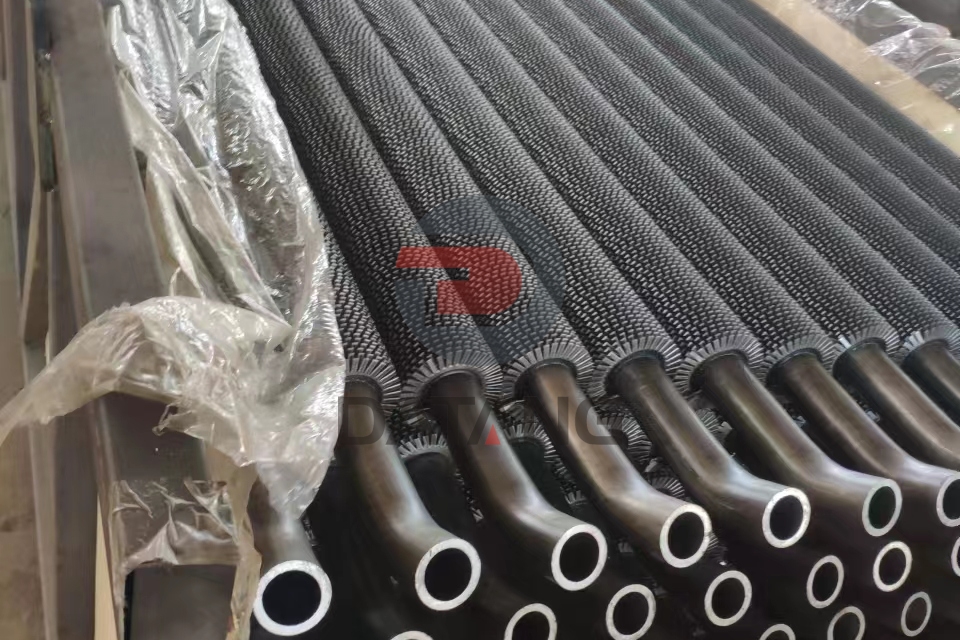
High-efficiency serrated fin tubes manufactured for industrial heat exchanger applications.
Typical Construction
- Base tube: carbon steel, stainless steel, alloy steel, copper alloy or titanium
- Fin strip: aluminum, carbon steel, stainless steel or special alloys
- Bonding method: high-frequency welding, laser welding or mechanical winding with knurled interference fit
- Fin profile: serrated / toothed spiral fin
Why Engineers Choose Serrated Fin Tubes
Higher Air-Side Efficiency
Serrations disrupt the boundary layer and create stronger turbulence, increasing convective heat transfer without excessively increasing exchanger size.
Stronger Fin Bonding
The knurled tube surface increases mechanical interlocking and reduces the risk of fin loosening during vibration or thermal expansion cycles.
Lower Thermal Resistance
Improved contact between the fin and the tube reduces interface resistance and allows heat to transfer more effectively from the process fluid to the air.
Longer Service Life
Better bonding integrity helps maintain thermal performance over years of operation in power plants, refineries and offshore environments.
Engineering Insight
In many air cooler and waste heat recovery applications, the air side contributes the majority of the total thermal resistance. Improving air-side turbulence often provides a larger performance gain than simply increasing fin surface area.
Serrated Fin Tube Structure
- Base Tube: pressure-bearing component carrying the process fluid.
- Knurled Surface: textured tube surface that enhances mechanical grip.
- Serrated Fin Strip: toothed spiral fin that increases turbulence.
- Bonding Interface: welded or mechanically locked contact area.
- Protective Coating (optional): corrosion-resistant treatment for offshore or aggressive environments.
How Does a Serrated Fin Tube Work?
- Hot process fluid flows inside the base tube.
- Heat conducts through the tube wall to the fin root.
- The serrated fin dramatically increases external surface area.
- Air flowing across the fin encounters repeated serration interruptions.
- These interruptions generate vortices and boundary-layer re-development.
- The enhanced turbulence increases the air-side heat transfer coefficient.
Boundary Layer Effect
A smooth fin allows a relatively stable boundary layer to grow along its surface. A serrated fin repeatedly breaks this layer, exposing fresh fluid to the heated surface and maintaining a higher local heat transfer coefficient.
Heat Transfer Advantages
Higher Convective Coefficient
Serrations increase air turbulence and improve convective heat transfer.
Lower Contact Resistance
Knurled bonding reduces thermal resistance at the fin-to-tube interface.
Better Fin Efficiency
More of the fin surface remains thermally active under operating conditions.
Optimized Pressure Drop
Proper serration geometry can improve heat transfer without a proportional pressure-drop penalty.
Project Example: Customized Serrated Fin Tubes for Air Cooler Manufacturer
One of our international customers required customized serrated fin tubes for a large air-cooled heat exchanger used in a continuous industrial production line. The project demanded excellent air-side heat transfer performance while maintaining stable operation under elevated temperatures.
After reviewing the customer’s thermal design and operating conditions, our engineering team optimized the fin geometry, selected appropriate tube and fin materials, and manufactured the fin tubes according to the approved drawings. Strict dimensional inspection and quality verification were carried out before shipment to ensure consistent performance.

Customized manufacturing based on customer drawings and operating requirements.
Serrated Fin Tube vs Other Fin Types
| Feature | L Fin | LL Fin | G Fin | Serrated Fin |
|---|---|---|---|---|
| Air-side heat transfer | Medium | Medium-High | High | Very High |
| Mechanical bonding | Good | Good | Very Good | Excellent |
| Vibration resistance | Fair | Good | Very Good | Excellent |
| Typical service temperature | Low-Medium | Medium | Medium-High | High |
| Best application | HVAC | General industry | Refinery / power | Air coolers / WHR / LNG |
Available Materials
Base Tube Materials
- Carbon Steel (SA179, SA192, SA210)
- Alloy Steel (T11, T22, T91)
- Stainless Steel (304, 316L, 321, 347H)
- Duplex Stainless Steel
- Copper & Copper Alloys
- Titanium (Grade 2)
Fin Materials
- Aluminum 1060 / 1100Aluminum 3003
- Carbon Steel Strip
- Stainless Steel Strip
- Special Corrosion-Resistant Alloys
Manufacturing Process
Reliable thermal performance depends not only on fin geometry but also on precise manufacturing control. Our production process is designed to ensure consistent fin pitch, strong bonding and dimensional accuracy across long tube lengths.
Applications of Serrated (Knurled) Fin Tubes
Serrated fin tubes are widely used in industrial heat exchange equipment where high heat transfer efficiency, excellent airflow performance, and long-term mechanical reliability are required. The segmented fin structure generates controlled air turbulence while reducing boundary layer resistance, making these fin tubes particularly suitable for gas-side heat transfer applications.
Compared with conventional solid fin tubes, serrated fin tubes provide superior performance in environments involving large air volumes, elevated temperatures, dusty conditions, or continuous industrial operation.
 Typical industrial applications of serrated fin tubes.
Typical Industries
- Power GenerationEconomizers, boiler heat recovery systems, air preheaters, and flue gas heat exchangers operating under high-temperature conditions.
- Oil & GasGas processing plants, compressor aftercoolers, LNG vaporization systems, offshore platforms, and refinery process heaters.
- Petrochemical IndustryHeat recovery units, fired heaters, reactor cooling systems, and hydrocarbon processing equipment.
- Chemical ProcessingCorrosive gas cooling, solvent recovery, chemical reactors, and process heat exchangers.
- Cement PlantsWaste heat recovery boilers (WHRB), kiln exhaust gas recovery, clinker cooling systems, and energy-saving projects.
- Steel & MetallurgyBlast furnace gas cooling, coke oven gas recovery, sintering systems, and industrial furnace heat recovery.
- Marine & Offshore EngineeringAir coolers, engine exhaust heat recovery, marine boiler systems, and offshore processing platforms.
- Renewable EnergyBiomass boilers, waste-to-energy plants, geothermal systems, and combined heat & power projects.
Why Serrated Fin Tubes Perform Better in Industrial Heat Exchangers
Many engineers assume that increasing fin surface area alone improves heat transfer. In reality, airflow characteristics are equally important.
A conventional solid fin allows a relatively stable boundary layer to develop as air moves across the fin surface. This insulating layer gradually reduces heat transfer efficiency.
Serrated fins interrupt this boundary layer repeatedly. Each serration creates localized turbulence that continuously renews the airflow adjacent to the fin surface. As a result, convective heat transfer is significantly enhanced while pressure drop remains within an acceptable range.
 Serrated fins continuously disturb the thermal boundary layer, improving air-side heat transfer.
Main Performance Advantages
- Higher air-side heat transfer coefficient
- Reduced thermal boundary layer thickness
- Improved turbulence without excessive pressure loss
- Higher overall heat exchanger efficiency
- Suitable for high-temperature gas applications
- Excellent long-term thermal stability
- Reduced fouling tendency in many operating conditions
- Lower operating cost through improved energy recovery
Engineering Experience from Global Projects
At Datang, serrated fin tubes are manufactured for customers serving power generation, petrochemical processing, industrial boilers, waste heat recovery systems, and air-cooled heat exchangers.
Our production capability covers both standard specifications and fully customized designs based on customer drawings, thermal calculations, and project requirements.
Every project begins with a detailed technical review, including operating temperature, working pressure, fin geometry, tube material, corrosion allowance, and installation conditions. This engineering-oriented approach helps ensure optimal heat transfer performance while maintaining long service life.
 Precision manufacturing ensures consistent fin geometry and reliable product quality.
Strict Quality Inspection Throughout Manufacturing
Consistent product quality is essential for heat exchanger performance. Every serrated fin tube is manufactured under a comprehensive quality control process covering raw materials, production, dimensional inspection, and final testing.
Incoming Material Inspection
- Material certificates verification
- Chemical composition confirmation
- Mechanical property verification
- Tube dimensional inspection
- Fin strip thickness inspection
Production Quality Control
- Continuous fin pitch monitoring
- Fin height measurement
- Tube straightness inspection
- Knurling quality verification
- Mechanical bonding inspection
Final Inspection
- Overall dimensional inspection
- Visual appearance inspection
- Surface finish evaluation
- Packaging inspection
- Customer-required third-party inspection available
 Every production batch undergoes strict inspection before delivery.
Why Global Customers Choose Datang
Selecting the right fin tube supplier is about more than manufacturing capability. It requires engineering expertise, stable quality, flexible production, and reliable project support.
 Professional manufacturing and engineering support for global heat exchanger projects.
Engineering Support
Professional recommendations based on operating conditions, thermal performance requirements, and project specifications.
Customized Manufacturing
OEM and customized production according to customer drawings, international standards, or specific project requirements.
Strict Quality Management
Comprehensive inspection procedures ensure consistent quality from raw materials to finished products.
Worldwide Export Experience
Serving customers across Asia, Europe, the Middle East, South America, Africa, and other international markets.
Flexible Material Options
Carbon steel, stainless steel, alloy steel, copper alloys, titanium, and other special materials are available.
Responsive Technical Service
Fast quotation, engineering consultation, production updates, and after-sales technical support throughout the project lifecycle.
How to Select the Right Serrated Fin Tube
Selecting the appropriate serrated fin tube involves much more than choosing a tube size. Engineers typically evaluate the entire heat transfer system, including operating conditions, thermal performance, corrosion resistance, maintenance requirements, and project life expectancy.
At Datang, our engineering team assists customers in optimizing fin geometry and material combinations to achieve the best balance between heat transfer efficiency, pressure drop, manufacturing cost, and equipment lifespan.
| Selection Factor | Engineering Recommendation |
|---|---|
| Working Temperature | Select suitable tube and fin materials according to operating temperature. |
| Corrosive Environment | Consider stainless steel, duplex stainless steel or special alloys. |
| Heat Transfer Requirement | Optimize fin height, fin pitch and fin thickness based on thermal calculations. |
| Dust Content | Larger fin spacing helps reduce fouling and simplifies cleaning. |
| Pressure Drop | Balance airflow resistance with maximum heat transfer efficiency. |
| Service Life | Select appropriate mechanical bonding and corrosion protection methods. |
Frequently Asked Questions
1. What is a serrated fin tube?
A serrated fin tube is a high-efficiency finned tube featuring segmented (toothed) fins wrapped or welded around the base tube. The serrations create turbulence that enhances air-side heat transfer while maintaining good airflow characteristics.
2. Why are serrated fins more efficient than solid fins?
The segmented fin structure repeatedly disrupts the thermal boundary layer, improving convective heat transfer and increasing overall heat exchanger efficiency.
3. What industries commonly use serrated fin tubes?
Power plants, petrochemical facilities, oil & gas processing, LNG projects, waste heat recovery systems, air coolers, marine engineering, and industrial boilers.
4. Which materials are available?
Carbon steel, stainless steel, alloy steel, copper alloys, aluminum, titanium, duplex stainless steel and other special materials are available depending on project requirements.
5. Can fin dimensions be customized?
Yes. Fin height, fin pitch, fin thickness, tube diameter and tube length can all be manufactured according to customer drawings or thermal design calculations.
6. What standards do your products follow?
Production can comply with ASTM, ASME, DIN, EN, JIS, GB and other international standards as required.
7. Can you manufacture according to our drawings?
Absolutely. OEM and customized production are one of our core strengths. Our engineering team reviews every drawing before manufacturing begins.
8. How is product quality ensured?
Each production batch undergoes raw material inspection, dimensional inspection, fin geometry verification, visual inspection, and customer-requested third-party inspection when required.
9. Do you export worldwide?
Yes. Our finned tubes have been supplied to customers in Europe, Southeast Asia, the Middle East, South America, Africa and many other international markets.
10. How can I request a quotation?
Simply provide your tube specification, fin dimensions, operating temperature, working pressure, material requirements, and quantity. Our engineering team will prepare a professional quotation together with technical recommendations.
Looking for a Reliable Serrated Fin Tube Manufacturer?
Whether you require standard finned tubes or fully customized heat transfer solutions, Datang provides professional engineering support, precision manufacturing, and strict quality control for customers worldwide.
Our experienced engineers can assist with material selection, fin design optimization, thermal performance recommendations, and customized manufacturing according to your project specifications.
Contact us today to discuss your application and receive a customized technical proposal and quotation.
Products categories
-

High frequency serrated finned tube
-

Serrated Fin Tube (Knurled Fin Tube) for High-E...
-

Serrated Fin Tube: The Ultimate Guide to Select...
-
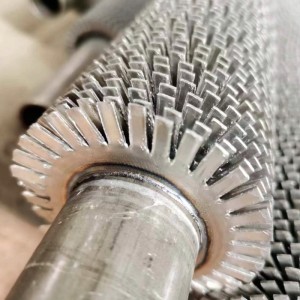
Stainless Steel Alloy Steel Serrated Finned Tube
-

KL Type Fin Tube (Knurled Finned Tube): The Ult...
-

G-Type Embedded vs. Spiral-Wound L, LL, and KL ...