
Introduction
Industrial heat recovery conditions can vary significantly from one region to another.
In some projects, the main challenge is recovering useful heat from strong solar radiation. In others, the heat source may be dusty boiler flue gas from a sugar mill or corrosive high-temperature gas from a mining and sulfuric acid plant.
Our spiral finned gravity heat pipes have been applied to different heat recovery and heating projects in Africa, including applications in Egypt, Tanzania and the Democratic Republic of the Congo (DRC).
These projects demonstrate how the same basic heat pipe principle can be adapted to very different operating environments by adjusting the tube material, fin configuration, fin spacing, heat pipe working conditions and overall heat exchanger design.
The following examples represent three typical application scenarios.
1. Egypt: Solar Thermal Heat Collection for Industrial Hot Water
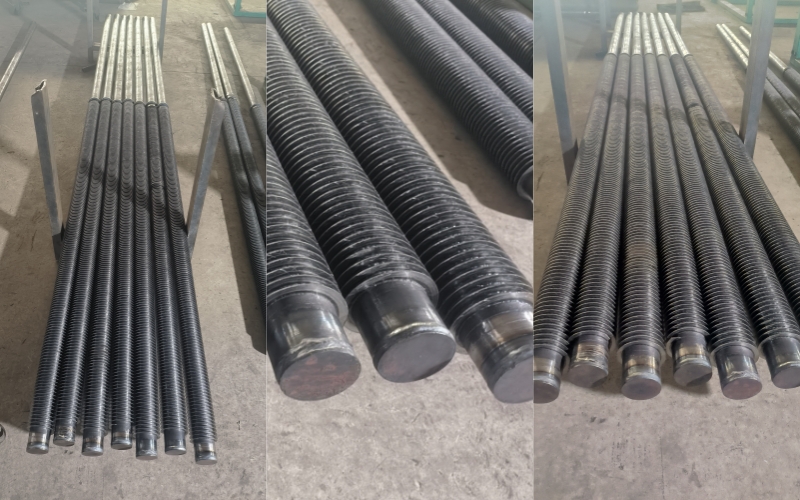
Project Background
Egypt has abundant solar radiation, particularly in desert and semi-desert regions.
For industrial plants, large camps and facilities located in areas with high solar availability, solar thermal systems can be used to convert solar energy into useful thermal energy.
One application of heat pipe technology is the heat-pipe-type solar thermal collector, where heat pipes transfer solar energy absorbed by the collector into a heat collection system.
The recovered solar heat can then be used to produce hot water for:
- Industrial processes
- Worker accommodation
- Large camps
- Sanitary hot water
- Facility heating
- Other low- and medium-temperature thermal requirements
How the Heat Pipe Works in a Solar Collector
The heat pipe is installed inside or connected to the solar collector.
When sunlight heats the absorber surface, thermal energy is transferred to the evaporation section of the heat pipe.
The working fluid inside the sealed heat pipe absorbs this energy and evaporates.
The vapor moves toward the cooler condensation section and releases its latent heat.
The condensed liquid then returns to the heated section, allowing the cycle to continue.
This passive phase-change process enables the heat pipe to transfer thermal energy efficiently from the solar absorber toward the water-heating side.
Why Heat Pipes Are Suitable for This Application
For solar thermal systems, the heat pipe provides a compact method of transferring energy from the solar collector to the heat collection system.
The design can also be adapted according to:
- Required water temperature
- Solar radiation conditions
- Collector dimensions
- Heat pipe length
- Working temperature
- Installation orientation
- Required thermal capacity
For large industrial or camp applications, multiple heat pipes can be integrated into a larger solar thermal collector system.
2. Tanzania: Gravity Heat Pipes for Sugar Mill Waste Heat Recovery
Project Background
Sugar production is an important industrial sector in Tanzania and across East Africa.
Sugar mills generate substantial quantities of thermal energy during the combustion of bagasse, the fibrous residue remaining after sugarcane processing.
A typical sugar mill may have:
Sugarcane → Juice extraction → Evaporation → Sugar processing
while bagasse generated during processing can be burned in boilers to provide steam and process heat.
The resulting boiler flue gas still contains recoverable thermal energy.
This creates an opportunity for gravity heat pipe heat exchangers to recover heat from the exhaust gas.
Recovering Heat from Bagasse Boiler Flue Gas
A heat pipe heat exchanger can be installed in a suitable section of the flue gas system.
The hot flue gas passes across the evaporation section of the heat pipes.
Heat is absorbed by the working fluid inside the sealed pipes.
The working fluid evaporates and transfers heat toward the condensation section.
On the cold side, the vapor condenses and releases the recovered heat to another medium.
Depending on the system design, recovered heat may be used for:
- Combustion air preheating
- Process air preheating
- Process water preheating
- Sugar production processes
- Boiler feedwater-related applications
- Other plant heating requirements
Engineering Challenge: Dust from Bagasse Combustion
One of the important design considerations in a sugar mill is flue gas dust loading.
Bagasse combustion can generate significant quantities of particulate matter.
If fin spacing is too small, dust can accumulate between the fins and gradually restrict gas flow.
Therefore, the fin configuration should not simply maximize the heat transfer area.
Instead, the design needs to consider a balance between:
Heat transfer area + gas-side pressure drop + ash/dust accumulation + cleaning requirements
For dusty flue gas applications, a relatively larger fin pitch can be considered to reduce the risk of blockage and make cleaning easier.
This is an important difference between designing a finned heat pipe for clean air and designing one for industrial boiler exhaust.
Material Selection for Sugar Mill Applications
For many conventional bagasse boiler applications, carbon steel may be suitable when the flue gas temperature and chemical conditions are within the material’s allowable operating range.
However, the actual gas composition and condensation conditions need to be evaluated.
Where higher corrosion resistance is required, stainless steel or other suitable materials can be considered.
Therefore, material selection should be based on the actual:
- Flue gas temperature
- Gas composition
- Sulfur content
- Moisture level
- Dew point
- Dust loading
- Expected service life
rather than simply selecting a material based on the application name.
3. Democratic Republic of the Congo: Gravity Heat Pipes for Mining and Sulfuric Acid Heat Recovery
Project Background
The Democratic Republic of the Congo is an important center for copper and cobalt production, with major mining and processing activities concentrated in areas such as Lualaba Province and Kolwezi.
Mining and metallurgical facilities may include:
- Copper and cobalt mines
- Hydrometallurgical plants
- Smelting facilities
- Sulfuric acid plants
- Diesel power generation systems
- Process heating systems
Many remote mining and industrial facilities also have limited access to stable grid electricity and therefore operate their own power generation or energy systems.
These conditions make passive and relatively low-maintenance heat recovery technologies particularly interesting.
Sulfuric Acid Plant Heat Recovery
One of the important heat recovery opportunities is found in sulfuric acid production associated with metallurgical operations.
Sulfur-containing gases generated during metallurgical processing can be processed through sulfuric acid production systems.
High-temperature gas streams may be present around equipment such as:
- Sulfur-burning furnaces
- Gas conversion sections
- Heat recovery sections
- Associated process gas systems
The thermal energy contained in these gas streams can potentially be recovered using a properly designed heat pipe heat exchanger.
How a Finned Gravity Heat Pipe Can Recover Heat
In a typical arrangement, hot process gas flows across the evaporation section of the heat pipe.
The working fluid inside the sealed tube absorbs heat and vaporizes.
The vapor moves toward the condensation section and releases heat.
The condensate then returns to the hot section through gravity.
The recovered thermal energy can potentially be used to produce:
- Hot water
- Process water
- Steam
- Heating air
- Other useful process heat
In larger systems, multiple gravity heat pipes can be assembled into a heat exchanger bank.
The final application depends on the available temperature difference and the customer’s process requirements.
Corrosion and Dust: Key Design Considerations in Mining Applications
Mining and metallurgical environments can be considerably more demanding than clean-air applications.
Depending on the process, the gas may contain:
- Sulfur compounds
- Acid-forming components
- Fine dust
- Metallic particulates
- Moisture
These factors can influence both material selection and fin geometry.
For sulfur-containing gas, corrosion risk needs to be evaluated carefully, particularly when the gas temperature may approach conditions where acidic condensation can occur.
Depending on the actual process conditions, stainless steel or other corrosion-resistant materials may be considered for the heat pipe and/or fin components.
Larger Fin Pitch for Dusty Gas
Dust is another important consideration.
A high-fin-density configuration may provide a larger heat transfer area, but it can also increase the possibility of dust accumulation.
For dusty mining and metallurgical gases, engineers may therefore consider:
- Larger fin pitch
- Appropriate fin height
- Lower risk of blockage
- Easier cleaning access
- Acceptable gas-side pressure drop
The goal is not simply to maximize the number of fins.
The objective is to achieve a practical balance between heat recovery performance and long-term maintainability.
Why Gravity Heat Pipes Are Attractive for Remote Industrial Sites
Remote mining areas can present unique operational challenges.
A heat recovery system that relies heavily on pumps, moving components or complex auxiliary equipment may increase maintenance requirements.
A gravity heat pipe uses the natural circulation of the internal working fluid through evaporation, vapor movement, condensation and gravity-driven return.
This makes the heat pipe itself a passive heat transfer component.
Potential advantages include:
- No internal circulation pump
- Few moving parts
- Passive working-fluid circulation
- Modular heat exchanger construction
- Relatively simple mechanical arrangement
- Potentially reduced maintenance requirements
However, the complete heat recovery system can still require fans, dampers, pumps or other equipment depending on how the recovered heat is used.
Therefore, it is more accurate to describe the heat pipe itself as a passive heat transfer component rather than assuming that the entire heat recovery system is pump-free.
Three African Applications, Three Different Design Challenges
The projects in Egypt, Tanzania and the DRC demonstrate why heat pipe design needs to be application-specific.
| Application | Main Heat Source | Main Challenge | Important Design Considerations |
|---|---|---|---|
| Egypt | Solar radiation | Efficient solar-to-thermal transfer | Working temperature, collector design, orientation |
| Tanzania | Bagasse boiler flue gas | Dust and ash accumulation | Fin pitch, cleaning, corrosion, pressure drop |
| DRC | Mining / metallurgical process gas | Dust and corrosive gas | Material selection, fin spacing, dew point, corrosion |
| DRC | Sulfuric acid process | High-temperature and sulfur-containing gas | Heat pipe material, thermal design, corrosion control |
This comparison also illustrates an important engineering principle:
The same heat pipe concept does not mean the same heat pipe specification.
The heat pipe should be designed around the actual operating environment.
From Standard Finned Tubes to Engineered Heat Pipe Solutions
A finned heat pipe is not simply a conventional finned tube with a working fluid added inside.
The internal working fluid, vacuum condition, sealing method and operating temperature range all influence the heat pipe’s performance.
At the same time, the external fin geometry determines how effectively heat can be transferred between the heat pipe and the surrounding gas.
Therefore, the complete design needs to consider both sides of the heat transfer process.
For a new project, important information includes:
- Heat source temperature
- Cold-side temperature
- Gas flow rate
- Required heat recovery capacity
- Gas composition
- Dust concentration
- Moisture content
- Corrosion conditions
- Installation orientation
- Available installation space
- Required outlet temperature
This information can then be used to evaluate an appropriate heat pipe and fin configuration.
Project Experience in Africa
Our spiral finned heat pipe products have been applied in different African markets, including Egypt, Tanzania and the Democratic Republic of the Congo.
These applications cover very different thermal environments—from solar thermal collection to sugar mill boiler waste heat recovery and mining/metallurgical process heat recovery.
The repeated use of the technology across different projects also provides practical experience in adapting heat pipe construction to different temperature, dust and corrosion conditions.
For industrial heat recovery projects, this application experience can be valuable because the final result depends not only on the heat pipe itself, but also on the interaction between the heat source, gas flow, fin geometry, material selection and complete heat exchanger design.
Conclusion
Spiral finned gravity heat pipes can be applied to a wide range of industrial thermal systems when the heat pipe structure and fin configuration are properly matched to the operating conditions.
In Egypt, heat pipe technology can support solar thermal systems for industrial and large-scale hot water applications.
In Tanzania, gravity heat pipe heat exchangers can be considered for recovering heat from dusty bagasse boiler flue gas and using the recovered energy for air or water preheating.
In the Democratic Republic of the Congo, the combination of gravity heat pipe technology and spiral fins can be evaluated for mining, metallurgical and sulfuric acid process heat recovery, where dust and corrosion require particular attention.
These projects demonstrate that successful heat recovery is not simply about selecting a high-efficiency tube. It requires an engineering approach that considers temperature, gas composition, dust loading, corrosion, fin spacing, pressure drop, heat recovery requirements and installation conditions together.
If you are planning a heat recovery, solar thermal or industrial air-heating project, you can provide your operating temperature, airflow, gas composition and required heat recovery capacity for a preliminary heat pipe configuration assessment.
Post time: Sep-08-2026