
Project Overview
Fishing vessel refrigeration systems operate under conditions that are considerably more demanding than conventional land-based cold storage systems.
For this project, the customer required a customized finned tube bank for an air-cooled condenser used in a fishing vessel refrigeration system. The condenser is responsible for removing heat from the high-temperature refrigerant discharged by the refrigeration compressor and condensing it before the refrigerant returns to the refrigeration cycle.
Unlike a conventional industrial or cold-room condenser, a marine refrigeration condenser must operate in an environment affected by salt-laden air, vibration, vessel movement, temperature fluctuations, and limited installation space.
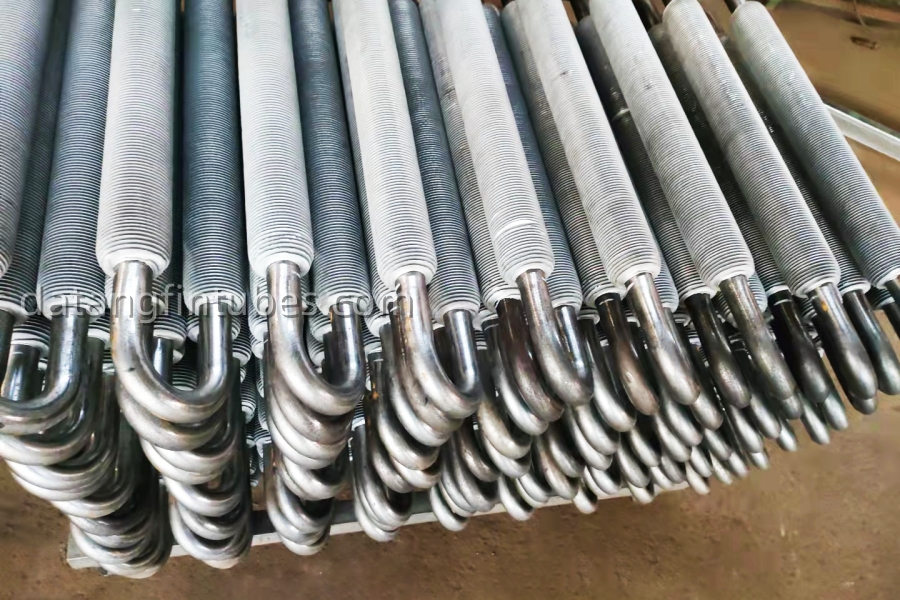
Based on the customer’s equipment requirements and operating conditions, we developed and supplied a customized condenser tube bank using wound finned tubes with a 42 mm outside diameter base tube.
Why Fishing Vessel Condensers Require a Different Finned Tube Design
A fishing vessel refrigeration system may be used for chilled fish storage, freezing, or other onboard cold-chain applications. The condenser can be installed in the engine room or on the deck, depending on the vessel configuration.
For an air-cooled condenser, the refrigerant flows inside the tubes while forced air passes over the external finned surface. Heat is transferred from the refrigerant through the tube wall and fins to the surrounding air.
The basic heat transfer principle is similar to that of a land-based air-cooled condenser. However, the operating environment is very different.
Marine applications can introduce several additional challenges:
- Salt-laden marine air can accelerate corrosion of exposed metal surfaces.
- Continuous vessel vibration can place additional mechanical stress on tube and fin connections.
- Vessel movement and repeated vibration can affect long-term structural reliability.
- High ambient temperatures can increase condensing pressure.
- Salt, dust and airborne contaminants can accumulate on the fin surface and restrict airflow.
- Installation space is often limited, requiring the condenser geometry to be adapted to the available equipment layout.
Therefore, the selection of the tube type, fin structure, tube arrangement and mechanical support cannot be based only on nominal heat transfer requirements.
Project Requirement
The customer was looking for a finned tube bank suitable for a fishing vessel refrigeration condenser.
The project required a solution that could provide effective air-side heat transfer while also considering the mechanical and environmental conditions associated with marine operation.
Instead of supplying a standard catalogue finned tube assembly, we evaluated the application requirements and developed the tube bank around the customer’s equipment configuration.
The final solution used:
- Wound finned tube construction
- 42 mm outside diameter base tube
- Customized finned tube bank arrangement
- Mechanical support adapted to the condenser structure
- Configuration designed for forced-air heat transfer
- Geometry customized according to the customer’s equipment requirements
The 42 mm base tube diameter was an important part of the final engineering configuration and was selected according to the customer’s condenser design rather than applying a standard small-diameter refrigeration tube.
Customized 42 mm OD Wound Finned Tube Bank
The core component supplied for this project was a wound finned tube with a 42 mm outside diameter base tube.
Wound finned tubes provide an extended external heat transfer surface by continuously forming fins around the base tube. This increases the effective heat transfer area available to the air side compared with a bare tube.
For a condenser tube bank, the final heat transfer performance is determined not only by the finned tube itself but also by the complete tube-bank configuration.
This includes factors such as:
- Base tube diameter
- Fin geometry
- Fin pitch
- Tube spacing
- Number of tube rows
- Air velocity
- Air-side pressure drop
- Refrigerant operating conditions
- Available installation space
- Cleaning and maintenance requirements
For this reason, the supplied component was treated as part of the complete condenser heat-transfer system rather than as an isolated finned tube product.
Engineering Considerations for Marine Operation
1. Vibration Resistance
Vibration is one of the major differences between fishing vessel refrigeration equipment and stationary refrigeration systems.
The vessel can experience continuous engine vibration as well as movement caused by waves and changing operating conditions. Over time, repeated mechanical loading can affect tube connections, fins, support structures and refrigerant piping.
For this reason, the finned tube bank needs adequate mechanical support and secure fixation within the condenser assembly.
The design should also avoid unnecessary rigid loading on connected refrigerant piping and should consider vibration isolation where required by the overall equipment design.
2. Salt-Air Corrosion
Marine air contains salt particles that can accelerate corrosion of exposed metal components.
For an air-cooled condenser installed on a vessel, corrosion protection should therefore be considered together with heat transfer performance.
Depending on the vessel location and material combination, protection may involve appropriate surface treatment, protective coatings and careful selection of materials for the tube, fins, side plates and support components.
The condenser should also be positioned and protected as far as practical from direct seawater spray.
3. Fin Spacing and Fouling
A condenser operating in a marine environment can gradually accumulate salt deposits, dust and other airborne contaminants on the fin surface.
If the fin spacing is too narrow for the actual operating environment, deposits can restrict airflow and increase air-side resistance. The resulting reduction in airflow can gradually reduce condenser performance.
Therefore, fin pitch should be selected as part of the overall thermal and maintenance design rather than simply maximizing the number of fins per unit length.
A practical condenser design needs to balance heat transfer area, airflow resistance and cleaning requirements.
4. High Ambient Temperature
Fishing vessels can operate in warm marine climates where ambient temperatures may become significantly higher than typical design conditions for indoor refrigeration equipment.
As ambient temperature increases, the condenser has less temperature difference available for rejecting heat. This can result in increased condensing pressure and additional load on the refrigeration compressor.
For this reason, the condenser heat-transfer area and airflow conditions should be evaluated using the actual design ambient temperature rather than relying only on standard indoor refrigeration conditions.
From Finned Tube to Complete Tube Bank
One of the important aspects of this project was that the requirement was not simply for individual finned tubes.
The customer needed a tube bank that could be incorporated into the air-cooled condenser assembly.
A complete condenser tube bank normally includes the finned tubes together with components such as headers or manifolds, side plates and support structures.
The tube arrangement affects both heat transfer and airflow distribution. In multi-row arrangements, staggered tube layouts can provide stronger air-side interaction than simple in-line arrangements, although the final arrangement needs to be determined according to the required heat transfer capacity and allowable pressure drop.
This is why we treat customized finned tube projects as engineering applications rather than simply standard tube orders.
Manufacturing and Quality Control
For a customized finned tube bank, dimensional consistency and mechanical integrity are particularly important because the tubes must fit accurately into the customer’s condenser structure.
Our production and inspection process focuses on the key characteristics required for the final assembly, including:
- Base tube outside diameter
- Fin dimensions and pitch
- Finned tube straightness
- Fin attachment condition
- Overall tube length
- Tube-bank dimensions
- Connection and assembly dimensions
- Visual inspection of the finished components
The final inspection is carried out according to the project requirements and applicable customer specifications.
Project Result
The completed solution provided the customer with a customized 42 mm OD wound finned tube bank for integration into a fishing vessel air-cooled condenser.
Rather than applying a standard land-based refrigeration condenser configuration, the project considered the marine operating environment, available installation space, mechanical requirements and air-side heat transfer conditions.
The result was a finned tube bank configuration developed specifically for the customer’s fishing vessel refrigeration equipment.
This project also demonstrates an important point for marine heat exchanger applications: finned tube selection should be based on the complete operating environment and equipment design, not only on nominal tube dimensions or heat transfer area.
Why Choose a Customized Finned Tube Solution?
For marine refrigeration and air-cooled condenser applications, the same finned tube specification may not be suitable for every vessel.
The required design can vary according to:
- Refrigeration capacity
- Refrigerant type
- Condensing temperature
- Ambient temperature
- Airflow and fan capacity
- Available installation space
- Marine exposure level
- Cleaning requirements
- Vibration conditions
- Tube-bank configuration
A customized solution allows the tube diameter, fin geometry, tube arrangement and overall dimensions to be matched to the customer’s actual condenser design.
For this fishing vessel project, the final configuration was based on a 42 mm outside diameter wound finned tube and was developed as part of the customer’s air-cooled condenser assembly.
Frequently Asked Questions
What type of condenser uses finned tube banks on fishing vessels?
Air-cooled condensers use finned tube banks to reject heat from the refrigerant to the surrounding air. They are different from seawater-cooled shell-and-tube condensers, where seawater flows through the heat exchanger for cooling.
Why are marine condenser finned tubes different from conventional refrigeration condenser tubes?
Marine condensers can be exposed to salt-laden air, vibration, vessel movement, temperature fluctuations and contamination. Therefore, material selection, corrosion protection, mechanical support, fin spacing and maintenance requirements may need to be considered differently from stationary land-based refrigeration equipment.
What is the advantage of a wound finned tube?
A wound finned tube increases the external heat transfer area around the base tube, allowing more heat to be transferred between the tube and surrounding air. Its actual performance depends on the tube diameter, fin geometry, fin pitch, airflow, tube arrangement and operating conditions.
Why was a 42 mm base tube used in this project?
The 42 mm outside diameter was part of the customer’s required condenser configuration. For customized heat exchanger projects, the base tube diameter is determined together with the thermal requirements, mechanical structure, refrigerant circuit and available installation space rather than selected independently.
Can you manufacture finned tube banks according to customer drawings?
Yes. Customized finned tubes and tube-bank assemblies can be developed according to customer drawings, equipment dimensions, operating conditions and required specifications. Technical information such as tube diameter, tube length, fin type, fin pitch, tube arrangement and operating conditions can be evaluated before production.
Technical Support for Customized Condenser Projects
A finned tube is only one part of a complete air-cooled condenser.
For fishing vessel refrigeration systems, the final design should consider the interaction between heat transfer, airflow, corrosion protection, vibration resistance, mechanical support and maintenance access.
If you are developing an air-cooled condenser for a fishing vessel, marine refrigeration system or other salt-air application, we can evaluate the application and manufacture customized finned tubes or tube banks according to your equipment requirements and drawings.
Please send us your condenser drawing, tube dimensions, required capacity and operating conditions for a technical evaluation.
Post time: Sep-04-2026