
Table of Contents
- 1. What Are High-Frequency Welded Finned Tubes?
- 2. The Science Behind High-Frequency Welding
- 3. Manufacturing Process and Welding Parameters
- 4. Solid vs. Serrated Fin Designs
- 5. How Fin Geometry Affects Heat Transfer
- 6. Base Tube and Fin Material Selection
- 7. Industrial Applications
- 8. High Frequency Welding vs. Laser Welding
- 9. Quality Control and Inspection
- 10. Maintenance and Service Considerations
- 11. How to Select the Right Finned Tube
- 12. DATANG Manufacturing Capabilities
- 13. Frequently Asked Questions
1. What Are High-Frequency Welded Finned Tubes?
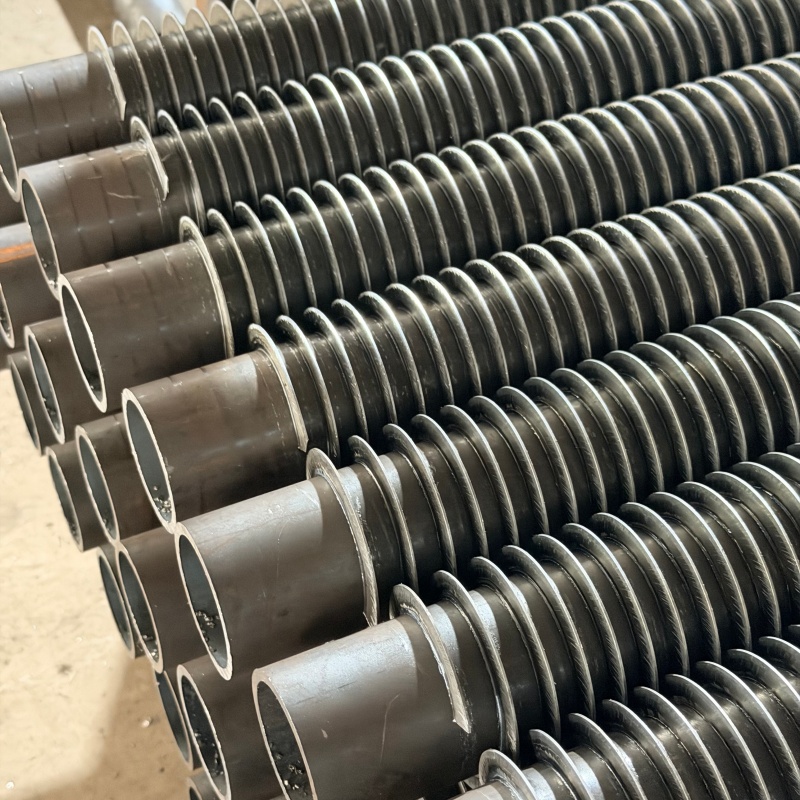
High-frequency welded finned tubes are heat transfer components manufactured by continuously welding a metal fin strip onto the outer surface of a base tube using high-frequency electrical resistance heating.
The base tube carries the working fluid, while the external fins increase the available heat transfer surface area. This design improves the exchange of heat between the fluid inside the tube and the surrounding air or gas.
Unlike mechanically attached finned tubes, high-frequency welded finned tubes use a metallurgical joining process to connect the fin strip to the base tube. This helps maintain reliable thermal contact and provides strong resistance to fin loosening during operation.
Main Structural Components
- Base Tube: The central tube that carries steam, water, oil, gas, or other process fluids.
- External Fin: A metal strip wound helically around the base tube to increase the external heat transfer area.
- Welded Joint: The metallurgical connection between the fin and base tube, formed through high-frequency resistance heating and mechanical pressure.
High-frequency welded spiral finned tubes are commonly used in economizers, air-cooled heat exchangers, industrial boilers, waste heat recovery equipment, and process heating systems.
2. The Science Behind High-Frequency Welding
High-frequency welding is a continuous resistance welding process. It uses high-frequency electrical current to generate localized heat at the contact area between the fin strip and the base tube.
The heating effect is concentrated around the joining area. Mechanical pressure is then applied to create a metallurgical bond between the two components.
How Does the Welding Mechanism Work?
During production, the base tube rotates while the metal fin strip is continuously fed and wound around its outer surface. High-frequency electrical energy heats the contact area, allowing the materials to reach suitable joining conditions.
The application of controlled pressure completes the welding process and forms a continuous fin-to-tube connection.
Why Is the Metallurgical Bond Important?
The connection between the fin and base tube directly influences thermal contact and mechanical stability.
A properly formed metallurgical bond helps reduce contact resistance compared with a conventional mechanical attachment. It also helps the fin remain securely attached when the tube experiences temperature changes, vibration, and routine cleaning operations.
However, actual heat transfer performance still depends on fin efficiency, material properties, surface conditions, and the complete heat exchanger design.
3. Manufacturing Process and Welding Parameters
Consistent manufacturing conditions are essential for producing reliable high-frequency welded finned tubes. Several stages must be controlled throughout production.
Step 1: Base Tube Preparation
The base tube is inspected for dimensional accuracy, surface condition, material requirements, and straightness before entering the production line.
Step 2: Fin Strip Preparation
The fin strip is selected according to the required material grade, thickness, height, and final fin geometry.
Step 3: Continuous Fin Winding
The base tube rotates while the fin strip is fed under controlled tension. The winding system determines the required spiral configuration and fin pitch.
Step 4: High-Frequency Welding
High-frequency electrical current generates localized resistance heating at the fin-to-tube contact area. Mechanical pressure is applied to establish the welded connection.
Step 5: Cooling and Finishing
After welding, the tube passes through the required cooling and finishing stages. The finished tube is then checked for dimensions, fin alignment, and weld consistency.
Important Manufacturing Parameters
| Parameter | Influence on Manufacturing |
|---|---|
| Welding power | Affects the localized heating conditions. |
| Welding speed | Influences production rate and welding conditions. |
| Fin strip tension | Helps maintain consistent fin winding. |
| Fin pitch | Determines fin spacing and density. |
| Welding pressure | Influences the formation of the welded joint. |
| Material compatibility | Affects welding behavior and joint quality. |
These parameters must be adjusted according to the tube dimensions, fin material, production equipment, and required product specifications. There is no single welding setting suitable for every material combination.
4. Solid vs. Serrated Fin Designs
High-frequency welded finned tubes are commonly manufactured with solid or serrated helical fin configurations. The choice depends on the operating environment, airflow characteristics, heat transfer requirements, and maintenance conditions.
Solid Helical Finned Tubes
Solid finned tubes use a continuous metal strip wound around the base tube and welded along the contact area.
- Continuous fin structure.
- Strong mechanical connection.
- Suitable for many general industrial heat transfer applications.
- Relatively straightforward inspection and maintenance.
- Available in different fin heights, thicknesses, and pitches.
Serrated Helical Finned Tubes
Serrated finned tubes have regularly spaced cuts along the fin strip, creating individual fin segments around the base tube.
The segmented geometry changes the airflow pattern around the fin surface. It can promote turbulence and disrupt the thermal boundary layer, potentially improving air-side heat transfer under suitable operating conditions.
- Segmented fin geometry.
- Potential improvement in air-side heat transfer.
- Different airflow characteristics compared with solid fins.
- Potential reduction in fin material weight for certain designs.
Comparison of Solid and Serrated Fins
| Feature | Solid Fin | Serrated Fin |
|---|---|---|
| Fin structure | Continuous strip | Segmented strip |
| Airflow pattern | More continuous flow path | Greater flow disturbance |
| Heat transfer behavior | Depends on fin geometry and operating conditions | May improve air-side heat transfer in suitable conditions |
| Cleaning | Depends on fin spacing and fouling characteristics | Depends on segment geometry and fouling characteristics |
| Typical selection | General heat transfer applications | Applications requiring modified airflow characteristics |
The final selection should consider thermal performance, pressure drop, fouling tendency, and cleaning requirements rather than fin configuration alone.
5. How Fin Geometry Affects Heat Transfer
Fin geometry is one of the key factors influencing the performance of a finned tube heat exchanger.
While increasing the external surface area can improve heat transfer potential, the actual performance depends on several interacting factors.
Fin Height
Increasing fin height provides additional external surface area. However, taller fins may also experience greater temperature gradients from the fin base to the fin tip. Fin efficiency should therefore be considered during thermal design.
Fin Thickness
Fin thickness affects mechanical strength, thermal conduction through the fin, material consumption, and manufacturing requirements.
Fin Pitch
Fin pitch refers to the distance between adjacent fins. A smaller pitch increases the number of fins per unit tube length, but may also increase airflow resistance and make cleaning more difficult.
Fin Diameter and Tube Diameter
The relationship between base tube diameter and fin outside diameter affects the total heat transfer surface area and the overall dimensions of the heat exchanger bundle.
Airflow and Pressure Drop
Air velocity, fin spacing, fin geometry, and tube arrangement all influence the pressure drop across a finned tube bundle.
For this reason, the most effective fin configuration is not necessarily the one with the greatest surface area. Engineers must balance heat transfer requirements with airflow resistance, fan power, fouling, and equipment space.
6. Base Tube and Fin Material Selection
The base tube and external fin may operate under different environmental conditions. Selecting appropriate materials is therefore essential for long-term equipment reliability.
Carbon Steel
Carbon steel is widely used for industrial finned tubes because of its availability, mechanical properties, and cost-effectiveness. It is commonly considered for boiler economizers, air heaters, and many conventional heat recovery systems.
Alloy Steel
Alloy steel grades may be selected for applications involving elevated temperatures or specific mechanical requirements. Material selection should follow the applicable design conditions and engineering specifications.
Stainless Steel
Stainless steel is often selected where corrosion resistance is an important consideration. The appropriate grade depends on the process fluid, external environment, temperature, and potential corrosive substances.
Bimetallic Material Combinations
Some applications require different materials for the base tube and external fin.
For example, a stainless steel base tube may be combined with carbon steel fins when the internal fluid requires corrosion resistance but the external environment permits the use of carbon steel.
Such combinations must be evaluated for material compatibility, thermal expansion, and welding suitability before production.
7. Industrial Applications
High-frequency welded finned tubes are used in many industrial heat transfer systems. Their application depends on the required thermal duty, working fluid, operating temperature, pressure, and external environment.
7.1 Industrial Boilers and Economizers
Boiler economizers recover energy from hot exhaust gases to preheat boiler feedwater. Finned tubes increase the available heat transfer surface area and help improve heat recovery within a limited equipment space.
7.2 Power Generation and Waste Heat Recovery
Power generation facilities and industrial plants produce exhaust gases containing recoverable thermal energy. Finned tube bundles can be incorporated into waste heat recovery equipment to transfer this energy to water, steam, or other working fluids.
7.3 Petrochemical and Oil Refining
Petrochemical plants and refineries use heat exchangers to control process temperatures and recover energy. Finned tubes may be applied in air-cooled heat exchangers and other process equipment, subject to suitable material and design selection.
7.4 Industrial Air-Cooled Heat Exchangers
Air-cooled heat exchangers use ambient air to remove heat from internal process fluids. Finned tubes increase the air-side heat transfer surface area and are used in oil cooling, gas cooling, and other industrial cooling applications.
7.5 Thermal Oil and Industrial Heating Systems
Thermal oil heaters and industrial heating equipment require reliable heat transfer between the working fluid and the surrounding environment. Finned tube components can be incorporated into customized heating and heat recovery systems according to the required operating conditions.
8. High Frequency Welding vs. Laser Welding
High-frequency welding and laser welding are two manufacturing technologies used to produce welded spiral finned tubes. Both methods create metallurgical connections, but their heat sources and process characteristics are different.
| Comparison | High Frequency Welding | Laser Welding |
|---|---|---|
| Heat source | High-frequency electrical resistance heating | Concentrated laser energy |
| Joining process | Resistance heating with mechanical pressure | Laser-based fusion welding |
| Heat input | Concentrated around the joining area | Highly localized |
| Production characteristics | Established continuous welding process | Precise and controlled welding process |
| Process considerations | Electrical conditions, pressure, speed, and material compatibility | Laser power, focus, speed, and material compatibility |
| Selection | Depends on product specifications and production economics | Depends on product specifications and welding requirements |
Neither technology is universally superior. The appropriate manufacturing method depends on tube dimensions, fin thickness, material combination, application requirements, production volume, and overall project cost.
For customers evaluating both technologies, comparing actual product quality, welding consistency, production efficiency, and total manufacturing cost is more useful than comparing the welding methods in isolation.
Learn more about our laser welded finned tubes and their manufacturing characteristics.
9. Quality Control and Inspection
Consistent product quality is essential for finned tubes used in industrial heat exchangers. Inspection procedures should cover both the base tube and the welded fin structure.
Dimensional Inspection
- Base tube outside diameter and wall thickness.
- Fin height and fin thickness.
- Fin pitch and alignment.
- Overall tube length.
- Product straightness and surface condition.
Weld Quality Inspection
The fin-to-tube connection should be checked for continuity and consistency. Suitable weld integrity tests may be specified according to the product design and customer requirements.
Material Verification
Base tube and fin materials should match the grades specified in the technical agreement. Material certificates and traceability records can be required according to project specifications.
Final Inspection
Finished products should be checked against the agreed drawings, dimensional tolerances, and inspection requirements before shipment.
Where required, additional testing and documentation can be arranged according to the applicable project standards and customer specifications.
10. Maintenance and Service Considerations
Even well-manufactured finned tubes require appropriate maintenance to maintain heat exchanger performance.
Fouling and Dust Accumulation
Dust, ash, oil deposits, and other contaminants can accumulate between the fins. This reduces the effective heat transfer surface and restricts airflow.
Regular inspection and cleaning should be planned according to the operating environment and fouling characteristics.
Corrosion Inspection
Both the fin surface and exposed base tube areas should be checked for corrosion. Particular attention should be given to humid environments, corrosive gases, and areas where deposits can retain moisture.
Vibration and Mechanical Stability
High gas velocities and mechanical vibration can affect heat exchanger tube bundles. Periodic inspections should check for signs of vibration damage, loose supports, deformation, and abnormal wear.
Cleaning Methods
Cleaning methods should be selected according to fin spacing, fin thickness, material properties, and equipment design. High-pressure water or mechanical cleaning should follow appropriate operating procedures to avoid damaging the fin structure.
11. How to Select the Right High-Frequency Welded Finned Tube
Correct finned tube selection begins with understanding the actual heat exchanger operating conditions. The following information helps manufacturers evaluate a suitable configuration.
1. Working Fluid
Identify the fluid inside the base tube, such as water, steam, thermal oil, or process gas.
2. Operating Temperature and Pressure
These conditions influence the base tube material, wall thickness, and overall mechanical design.
3. External Environment
Consider ambient temperature, humidity, corrosive substances, dust, and other external conditions.
4. Required Heat Transfer Capacity
The thermal duty is essential for determining the required heat transfer surface area and tube arrangement.
5. Airflow and Pressure Drop
Air velocity and allowable pressure drop help determine the appropriate fin pitch, fin height, and tube arrangement.
6. Product Dimensions and Materials
Provide the base tube diameter, wall thickness, fin height, fin thickness, fin pitch, tube length, and required material grades.
7. Drawings and Project Specifications
Existing drawings, technical documents, or physical samples can help manufacturers understand the requirements and recommend a suitable product configuration.
For customized finned tube projects, providing complete operating conditions is more useful than requesting a quotation based on tube dimensions alone.
12. DATANG Manufacturing Capabilities
Cangzhou Datang Steel Pipe Co., Ltd. specializes in finned tube manufacturing and finned tube production equipment. Our product range covers different welding and fin attachment technologies for industrial heat transfer applications.
Our Finned Tube Product Range
- High Frequency Welded Finned Tubes
- Laser Welded Finned Tubes
- Extruded Finned Tubes
- Embedded G-Type Finned Tubes
- L-Type Finned Tubes
- Solid and Serrated Spiral Finned Tubes
- Customized Finned Tube Coils
Different manufacturing technologies offer different advantages. We help customers evaluate suitable finned tube structures, material combinations, and manufacturing requirements according to their applications.
Finned Tube Production Equipment
In addition to supplying finished finned tubes, DATANG also manufactures finned tube production lines, including high-frequency welded finned tube machines and laser welded finned tube equipment.
This combination of product manufacturing and production equipment experience gives us practical insight into finned tube processing, welding technology, and production requirements.
For customers developing their own finned tube manufacturing operations, we can also discuss suitable production equipment configurations.
Our goal is to provide practical manufacturing solutions that meet different industrial heat transfer and production requirements.
13. Frequently Asked Questions
What is the difference between high-frequency welded and mechanically bonded finned tubes?
High-frequency welded finned tubes use a metallurgical joining process to connect the fin to the base tube. Mechanically bonded finned tubes rely on physical attachment methods. The appropriate option depends on operating temperature, mechanical requirements, and application conditions.
Are high-frequency welded finned tubes suitable for high-temperature applications?
They can be used in many high-temperature industrial applications. However, the maximum operating temperature depends on the base tube material, fin material, weld quality, thermal expansion, and equipment design.
What is the difference between solid and serrated finned tubes?
Solid finned tubes have continuous fins, while serrated finned tubes have segmented fins. Serrated designs can promote airflow turbulence and improve air-side heat transfer under suitable conditions. Solid designs provide a continuous fin structure and are widely used in general industrial applications.
Which materials are commonly used for high-frequency welded finned tubes?
Common base tube materials include carbon steel, alloy steel, and stainless steel. Fin materials may include carbon steel and stainless steel, depending on the required material combination and manufacturing suitability.
How does fin pitch affect heat exchanger performance?
Fin pitch determines the spacing between adjacent fins. A smaller pitch can increase the external heat transfer surface area per unit tube length, but it may also increase airflow resistance and fouling sensitivity.
Can high-frequency welded finned tubes be customized?
Yes. Base tube dimensions, fin height, fin thickness, fin pitch, material grades, and tube length can be customized according to manufacturing capabilities and project requirements.
How do I choose between high-frequency welding and laser welding?
The selection depends on product dimensions, fin material, welding requirements, production volume, operating conditions, and manufacturing economics. Comparing actual product requirements and production capabilities is the best way to select a suitable process.
Discuss Your Finned Tube Requirements with DATANG
Selecting the right finned tube is an important step in designing reliable and efficient industrial heat exchangers.
At Cangzhou Datang Steel Pipe Co., Ltd., we provide finned tube manufacturing solutions and production equipment for customers across different industrial sectors.
Whether you need high-frequency welded finned tubes, laser welded finned tubes, or customized finned tube configurations, our team can review your technical drawings, material requirements, and application conditions.
Contact DATANG to discuss your next finned tube project.
Post time: Nov-25-2026