
The Definitive Guide to Fin Tubes: Extruded vs. High-Frequency Welding (HFW)
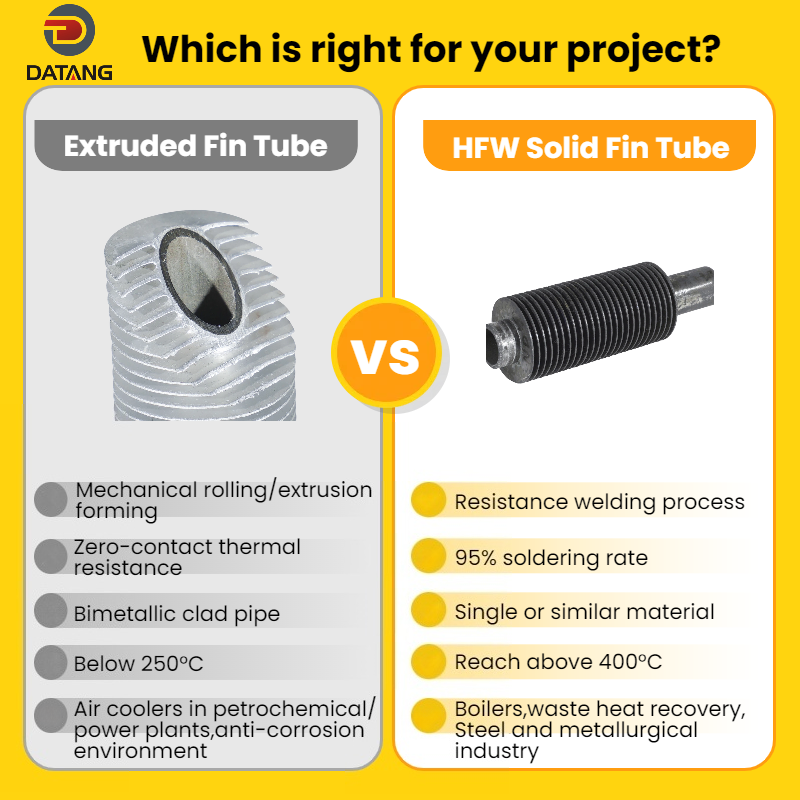
I. Core Differences: Manufacturing Process
Feature Dimension |
Extruded Fin Tube |
High-Frequency Welding (HFW) Fin Tube |
| Manufacturing Process | Mechanical Rolling/ExtrusionThe outer metal (e.g., aluminum) is cold-extruded onto the
base tube under high pressure. |
Electrical Resistance WeldingUtilizing the skin effect of high-frequency current, a steel strip (fin)
is spirally welded onto the surface of the steel pipe (base tube). |
| Bonding Method | Gap-Free BondingMetallurgical bonding or extremely tight mechanical
contact between the fin and tube, resulting in zero contact resistance. |
Fusion WeldingThe fin and base tube are joined by melting the materials together,
leaving a visible weld seam. |
| Material Combination | Primarily Bi-metallic Composite Tubes(e.g., Carbon/Stainless Steel base tube with an Aluminum
outer tube extruded into fins). |
Primarily Single or Similar Materials(e.g., Carbon steel tube + Carbon steel fins, or Stainless Steel
+ Stainless Steel). |
| Corrosion Resistance | ExcellentThe aluminum fin surface forms a protective oxide layer,
and the base tube has no exposed surface. |
ModerateThe weld seam is susceptible to galvanic corrosion and requires
post-treatment (e.g., galvanizing, painting). |
II. Performance Comparison: Mechanical & Thermal Properties
Advantage Point |
Extruded Fin Tube |
HFW Fin Tube |
| Thermal Resistance / Efficiency | ⭐⭐⭐⭐⭐ Extremely LowFins are tightly integrated with the base tube;
virtually no contact resistance. |
⭐⭐⭐ Moderate/LowDepends on weld quality; some welding resistance exists. |
| Mechanical Strength |
⭐⭐⭐⭐ High
Fins are integrally formed, offering strong resistance
to impact and vibration. Fins are resistant to bending.
|
⭐⭐⭐⭐⭐ Very HighFusion-welded connection provides high joint strength,
ideal for extremely high-pressure applications. |
| Max. Operating Temperature | ⭐⭐⭐ Medium/High (Approx. 250°C – 300°C / 480°F – 570°F)Limited by the melting point of aluminum; aluminum softens at high temperatures. | ⭐⭐⭐⭐⭐ Extremely High (Above 400°C / 750°F)All-steel/stainless structure withstands high temperatures,
suitable for flue gas and waste heat recovery. |
| Fin Density | HighCapable of very dense fins (fins per inch), maximizing
heat transfer surface area. |
Medium/LowFin pitch is typically wider due to welding process limitations. |
III. Applica tions & Industry Use Cases
Scenario |
Extruded Fin Tube Applications |
HFW Fin Tube Applications |
| Air Coolers | Preferred ChoiceEspecially in petrochemical and power plant air-cooled heat exchangers,
leveraging aluminum’s high thermal conductivity and lightweight properties. |
Less CommonUsed only when media temperatures are extremely
high (e.g., catalytic cracking units). |
| Boilers & Waste Heat Recovery | Partially ApplicableUsed in economizers (low-temperature sections) where
temperatures are within aluminum’s limits. |
Primary WorkhorseUsed in superheaters, reheaters, and high-temperature sections
of HRSGs, resisting high-temperature flue gas erosion. |
| Corrosive Environments | Preferred ChoiceAluminum’s oxide layer resists atmospheric corrosion, ideal for
coastal areas and external chemical plant atmospheres. |
Requires CautionWeld points are prone to rust; requires strict surface coating protection. |
| Typical Industries | Petrochemical, Power Generation, Construction Machinery,Refrigeration, Air Compressor Aftercoolers. | Steel, Metallurgy, Power Plant Boilers, Marine Power, Gas Turbine Cooling. |
Quick Selection Guide (Memory Aid)
Choose Extruded: For corrosion resistance and lower temperatures (Aluminum fins excel in corrosive air cooler environments but have temperature limits).
Choose HFW: For high temperatures and high wear resistance (All-steel construction withstands harsh thermal and mechanical stress but is less corrosion-resistant).
Post time: Mar-19-2026