What Makes 70/30 Cupro Nickel Tubes Ideal for Marine & Industrial Applications?
For engineers and procurement specialists in demanding industries like shipbuilding, power generation, and offshore oil & gas, selecting the right tubing material is a critical decision. It directly impacts system longevity, safety, and operational costs. Among the top-performing alloys, 70/30 Cupro Nickel (CuNi 70/30) stands out as a premier choice for challenging environments. This article provides a comprehensive guide to 70/30 Cupro Nickel tubes, detailing their properties, applications, and technical specifications to help you make an informed material selection.
Datang, as a leading manufacturer and global supplier, specializes in producing high-grade 70/30 Cupro Nickel tubes, engineered to deliver unmatched reliability where it matters most.
1. Overview of 70/30 Cupro Nickel Alloy
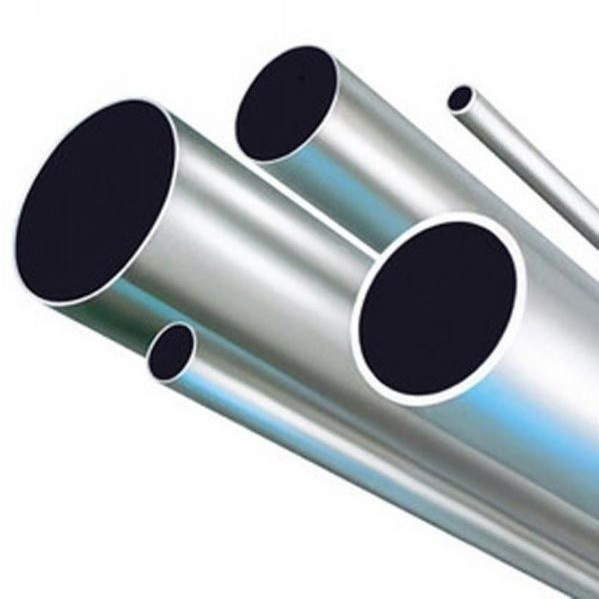
70/30 Cupro Nickel, also known as UNS C71500, is a copper-nickel alloy consisting of approximately 70% copper and 30% nickel, with small additions of iron and manganese. This specific composition is the key to its exceptional performance.
The alloy represents a significant evolution in metallurgy, designed to overcome the limitations of pure copper and other copper alloys in highly corrosive settings. The synergy between copper and nickel creates a material that is not only inherently robust but also develops a stable, protective oxide film upon exposure to seawater. This passive layer is the secret behind its legendary corrosion resistance, biofouling resistance, and long service life.
2. Key Properties & Advantages of CuNi 70/30 Tubes
Why is 70/30 CuNi so highly regarded? Its advantages stem from a unique combination of physical and mechanical properties.
Superior Corrosion Resistance
This is the most celebrated feature of 70/30 CuNi. It exhibits outstanding resistance to:
- Seawater and Saltwater Corrosion: It handles both low- and high-velocity seawater with minimal erosion-corrosion or impingement attack.
- Stress Corrosion Cracking (SCC): Highly resistant in marine atmospheres.
- Macro-fouling: The surface film mildly inhibits the attachment of marine organisms like barnacles and mussels, reducing maintenance.
Excellent Biofouling Resistance
While not completely fouling-proof, 70/30 CuNi tubes significantly slow down the growth of marine biological matter compared to other materials, leading to less frequent cleaning and maintained heat transfer efficiency in condensers and heat exchangers.
High Strength and Durability
The alloy offers good tensile and fatigue strength, retaining its mechanical properties across a wide temperature range. It is also highly ductile and can withstand vibration and thermal expansion stresses.
Fabricability and Weldability
70/30 CuNi tubes can be readily bent, formed, and welded using common techniques (TIG, MIG) and appropriate filler metals, facilitating easier installation and repair.
Antimicrobial Properties
Like many copper alloys, CuNi 70/30 has inherent antimicrobial (biocidal) properties, making it suitable for applications in desalination and potable water systems.
3. Primary Industrial Applications
The robust properties of 70/30 Cupro Nickel tubes make them indispensable across several heavy-duty industries:
- Shipbuilding & Marine Engineering: The quintessential application. Used for seawater piping systems, condensers, heat exchangers, cooling systems, and hydraulic lines due to unparalleled saltwater resistance.
- Power Generation (High-Capacity Plants): Critical in coastal and nuclear power stations for main condenser tubes, cooler tubes, and auxiliary cooling circuits where large volumes of seawater are used for cooling.
- Offshore Oil & Gas Platforms: Used in heat exchangers, desalination units (distiller tubes), firewater systems, and process cooling lines that are constantly exposed to aggressive offshore environments.
- Desalination Plants: Ideal for evaporator tubes and heat recovery sections in Multi-Stage Flash (MSF) and Multi-Effect Distillation (MED) plants due to corrosion and scaling resistance.
- Chemical and Process Industries: Selected for handling various salts, alkalis, and non-oxidizing acids in heat exchanger and condenser applications.
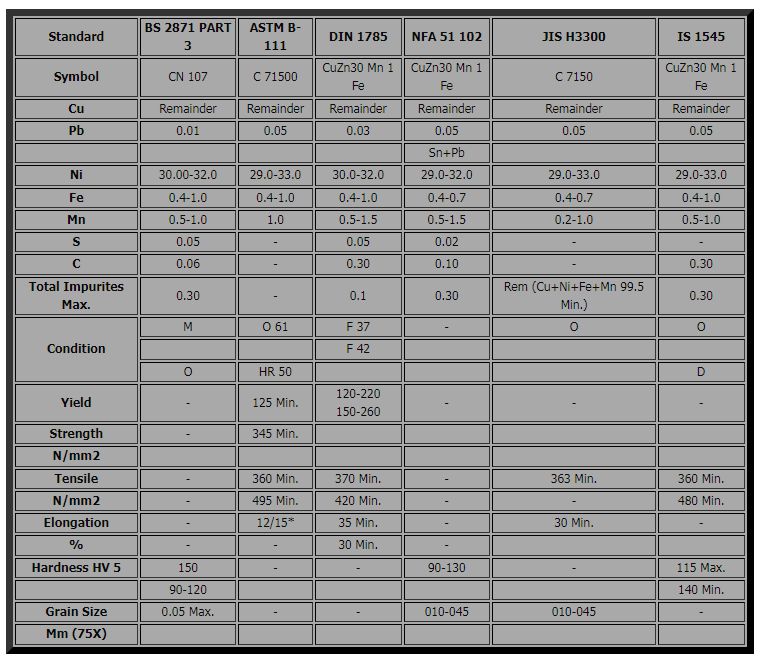
4. Technical Specifications & Standards
Datang’s 70/30 Cupro Nickel tubes are manufactured to meet rigorous international standards, ensuring consistency and performance.
| Property |
Typical Value / Specification |
| Common Standards |
ASTM B111 / B111M, ASTM B466 / B466M, ASTM B552, DIN 17760, EN 12449 |
| UNS Number |
C71500 |
| Nominal Composition |
Cu 70%, Ni 30%, Fe 0.7%, Mn 0.7% |
| Density |
8.94 g/cm³ |
| Melting Point |
~ 1210°C (2210°F) |
| Tensile Strength |
350 - 550 MPa (approx.) |
| Yield Strength (0.2% Offset) |
140 - 350 MPa (approx.) |
| Thermal Conductivity |
~ 29 W/m·K (at 20°C) |
| Max Operating Temperature |
Up to 400°C (752°F) in oxidizing atmospheres |
Available Forms: Seamless & Welded Tubes.
Sizes: A wide range of outer diameters and wall thicknesses is available, catering to specific project requirements from small-bore instrumentation lines to large condenser tubing.
5. How to Select the Right 70/30 CuNi Tubes
Choosing the correct tube involves more than just the alloy. Consider these factors:
- Application Environment: Full seawater, brackish water, or marine atmosphere? Velocity and temperature of the medium?
- System Design Pressure & Temperature: Determines the required wall thickness and pressure rating.
- Fabrication Needs: Will the tubes require extensive bending or welding on-site?
- Compatibility: Ensure compatibility with existing system materials to avoid galvanic corrosion.
- Certification: For critical applications, verify material certifications (e.g., EN 10204 3.1/3.2) from your supplier.
FAQ: Frequently Asked Questions about 70/30 Cupro Nickel Tubes
Q1: What is the main difference between 90/10 Cupro Nickel and 70/30 Cupro Nickel?
A1: While both are excellent for seawater service, 90/10 CuNi (C70600) contains 10% nickel and is a more cost-effective option for general marine use. 70/30 CuNi (C71500) has a higher nickel content (30%), providing significantly higher strength, better resistance to erosion-corrosion in high-velocity seawater, and superior resistance to sulfuric acid and other chemicals. It is the preferred choice for more severe conditions.
Q2: Can 70/30 CuNi tubes be welded easily?
A2: Yes, they have good weldability. Gas Tungsten Arc Welding (GTAW/TIG) and Gas Metal Arc Welding (GMAW/MIG) are commonly used. It is crucial to use matching or compatible filler metals (e.g., CuNi 70/30 or 70/30 with Nb stabilizer) and proper shielding gas to maintain corrosion resistance in the weld zone.
Q3: How does 70/30 CuNi perform against chlorination in seawater cooling systems?
A3: It has good resistance to chlorinated seawater (used for biofouling control), but excessive chlorination levels can damage the protective oxide film. It is important to maintain recommended residual chlorine levels (typically below 1 ppm) to ensure long-term performance.
Q4: Are these tubes suitable for freshwater or potable water systems?
A4: Absolutely. 70/30 CuNi is approved for potable water applications. Its corrosion resistance in fresh water is excellent, and its inherent antimicrobial properties provide an added health benefit.
Q5: What is the maximum continuous operating temperature for these tubes?
A5: In oxidizing atmospheres, 70/30 CuNi tubes can be used continuously at temperatures up to 400°C (752°F). Their high thermal stability makes them suitable for various heat exchanger applications.
Q6: Why source from a specialist manufacturer like Datang?
A6: As a dedicated manufacturer and exporter, Datang controls the entire production process—from raw material sourcing to final inspection. This ensures strict adherence to chemical composition, dimensional tolerances, and metallurgical integrity. We provide technical support, comprehensive certifications, and supply reliability that generic distributors cannot match, guaranteeing you receive tubes that perform as specified in your most critical applications.